What Documents Are Needed for a Mortgage in Principle?

Author: Jack Freestone
Finance Writer at Boon Brokers

Reviewed by: Gerard Boon
Managing Director at Boon Brokers

Estimated Read Time: 5 Minutes
The documents needed for a Mortgage in Principle (also called an Agreement in Principle) typically include payslips or self-employed tax documents, along with details of your employment, deposit and financial commitments.
Before viewing properties or making a serious offer on your potential dream house, a mortgage in principle can provide you with a clearer estimate of your mortgage budget, helping you narrow down the never-ending property listings down to your personal top contenders.
In this article, we explain exactly what lenders will request before issuing a mortgage in principle and how a mortgage in principle can help you find your perfect home. Let’s begin.
In this article...
- What Proof of Income Do You Need for a Mortgage in Principle?
- What Information Do Lenders Require?
- How Accurate Does the Information Provided Need to Be?
- What Happens After Getting Your Agreement in Principle?
- How Can a Mortgage Broker Help You Get a Mortgage in Principle?
- Frequently Asked Questions
What Proof of Income Do You Need for a Mortgage in Principle?
Income documents for a Mortgage in Principle will include payslips and a P60 for employed applicants, or Tax Calculations (SA302) and Tax Year Overviews for self-employed borrowers.
To apply for a Mortgage in Principle (MIP), lenders will ask for an overview of your income, employment and financial commitments. This forms part of their initial mortgage affordability assessment and helps determine your potential borrowing power.
The exact income documents for a mortgage in principle can vary depending on how you apply. If you apply through a mortgage broker, they will often review your income documents upfront to verify your circumstances and recommend the most suitable lenders.
In the case that you are applying directly to a lender, you will usually only be asked to provide the information needed for that lender’s own mortgage in principle assessment, with supporting documents requested later if you proceed to a full application.
Mortgage in Principle Documents for Employed Borrowers
For employed applicants, the documents required to apply for a mortgage in principle can include:
- Your latest three payslips
- Your most recent P60
- Details of your employer and job role
- Evidence of bonuses, commission or overtime, where applicable
Mortgage in Principle Documents for Self-Employed Borrowers
For self-employed applicants, the documents required to apply for a mortgage in principle can include:
- SA302 tax calculations
- Tax year overviews
- Accountant-prepared accounts
- Details of salary and dividends if you operate through a limited company
It’s important that the information you provide is as accurate as possible, as it will be verified during your full mortgage application. If any details are incorrect, or your verified income is lower than declared, the amount you can borrow may change or your application could be declined if you no longer meet the lender’s affordability criteria.
See What Our Clients Have To Say...
What Information Do Lenders Require?
The information lenders need to issue a Mortgage in Principle will include details of your identity, address history, income, existing financial commitments, and deposit.
Lenders request this information to complete an initial assessment of your finances to estimate how much you could potentially be able to borrow and determine whether you meet their initial lending criteria.
If you are applying through a mortgage broker, they will usually request and review this information and supporting documentation upfront to ensure you’re matched with the most suitable lenders for your application.
The table below summarises all the information lenders need for a Mortgage in Principle application:
What Information Do Lenders Need for a Mortgage in Principle?
| Information Lenders Need | What the Information Confirms |
| Identity | Confirm who you are |
| Address history | Verify where you’ve lived |
| Income | Assess affordability |
| Existing credit commitments | Understand current borrowing |
| Household expenditure | Assess affordability |
| Deposit | Confirm funds available |
At this stage, lenders will also usually carry out a soft credit check as part of their initial assessment. It’s important to note that a soft credit check provides an overview of your credit profile and does not affect your credit score.
If you later decide to proceed with a full mortgage application, your chosen lender will usually carry out a hard credit check as part of their final assessment.
How Accurate Does the Information Provided Need to Be?
The information you provide for a Mortgage in Principle needs to be as accurate as possible. While minor estimates are sometimes acceptable, inaccurate or misleading information could reduce how much you can borrow or affect your full mortgage application.
When applying for a Mortgage in Principle, the information you provide should be as accurate and honest as possible to reflect your genuine financial position.
The main reason for this is because a mortgage in principle will only ever be as accurate as the information it is based on. If incorrect figures are provided, you may receive a borrowing estimate that doesn’t match what you can realistically afford or your true mortgage eligibility.
For example, incorrect information on a Mortgage in Principle application could lead to:
- An inaccurate borrowing estimate
- Delays during your full mortgage application
- A reduced borrowing amount
- Your mortgage application being declined
The impact of incorrect details on a mortgage in principle often becomes a problem when a lender begins verifying the information provided.
If the information provided does not match the supporting evidence submitted later, the lender may determine that you cannot borrow as much as your mortgage in principle originally indicated.
For this reason, it is always better to provide realistic figures from the start, rather than relying on rough estimates. A slightly lower borrowing estimate based on accurate information is often far more useful than an inflated figure that may not be achievable when you come to submit a full mortgage application.
Speak to a Mortgage Broker
Ready to get your Mortgage in Principle? Our fee-free mortgage advisers can help you prepare and arrange one.
What Happens After Getting Your Agreement in Principle?
After receiving a mortgage in principle, you can use your estimated borrowing amount to guide your property search. When an offer is accepted, you will then submit a full mortgage application.
The next steps after securing a Mortgage in Principle will usually depend on where you are in the buying process. For most people, the journey after receiving an AIP will look something like this:
- Use your Mortgage in Principle to guide your property search
- View suitable properties within your estimated budget
- Make an offer on a property
- Have your offer accepted
- Submit a full mortgage application
- Provide the documents requested by the lender
- Wait for underwriting checks and the property valuation
- Receive a formal mortgage offer, if approved
In addition to this list, a mortgage in principle can also be used to demonstrate to estate agents that you are a serious buyer who has already taken the first step towards securing a mortgage.
It’s important to note that the move from a mortgage in principle to a full mortgage application is when your chosen lender will carry out a much more detailed assessment. This usually includes verifying your income, identity, bank statements, credit commitments and other supporting documents before deciding whether to issue a formal mortgage offer.
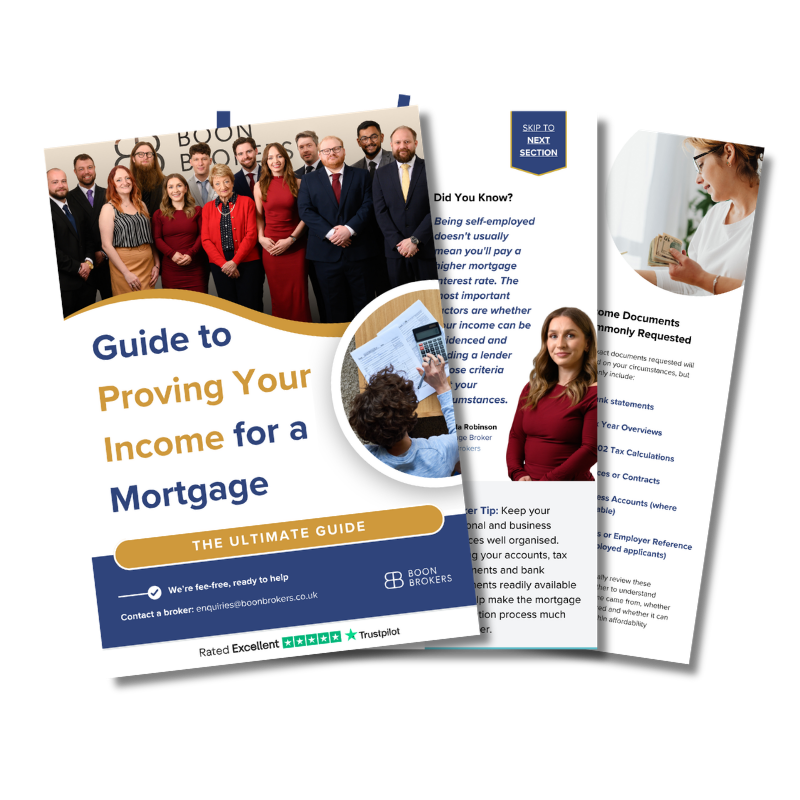
Download Our Free Mortgage Income Guide
Understand lender income requirements and avoid mistakes before applying for your mortgage.
How Can a Mortgage Broker Help You Get a Mortgage in Principle?
A mortgage broker can guide you through the Mortgage in Principle process, helping you identify suitable lenders and improving the chances of securing an accurate borrowing estimate.
A mortgage broker can assess your financial circumstances before recommending lenders whose criteria are most likely to suit your full mortgage application.
By reviewing your income, expenditure and supporting evidence at the start of your mortgage journey, a mortgage broker can match you with lenders whose criteria best suit your circumstances, increasing your chances of securing a Mortgage in Principle and progressing to a formal mortgage offer.
At Boon Brokers, our fee-free mortgage advisers help buyers understand exactly what lenders are looking for before an application is submitted. Whether you’re employed, self-employed or have more complex income arrangements, we can help you understand your options and prepare for the next stage of the mortgage process.
When it is time for you to move from a Mortgage in Principle to a full mortgage application, your lender will need to verify your income using supporting documents that are relevant to your circumstances. Understanding what proof of income is needed for a mortgage can help you prepare the right evidence and avoid unnecessary delays.
Need Mortgage Advice?
Submit an Enquiry
Frequently Asked Questions
Can I Get a Mortgage in Principle Online?
Yes. Many lenders let you apply for a mortgage in principle online, with some providing a decision within minutes. Although mortgage in principle requirements vary between lenders, you’ll usually need to provide details of your income, employment, financial commitments and borrowing requirements. Supporting documents are typically only requested if you proceed with a full mortgage application.
Do I Need Payslips for a Mortgage in Principle?
Not usually. Most lenders can issue a Mortgage in Principle using the information you provide rather than supporting documents. However, if you apply through a mortgage broker, payslips and other proof of income may be reviewed upfront to verify your circumstances and recommend lenders whose criteria best match your application.
How Many Bank Statements Are Needed for a Mortgage in Principle?
Usually none. Most lenders do not require bank statements to issue a mortgage in principle and instead rely on the information you provide. Bank statements are more commonly requested later as part of the documents for a mortgage application, alongside proof of identity, proof of address and evidence of income.
Jack Freestone
I’m an established content writer at Boon Brokers, where I write and publish financial and mortgage-focused content across the UK property and lending marketplace. My work covers topics including first-time buyers, remortgaging, equity release, and wider market developments affecting borrowers. I hold a Master’s degree in English Literature from the University of Bedfordshire, graduating with distinction. Since then, I’ve worked across freelance, agency, and in-house roles, building experience writing across a range of subjects, with a focus on topics that directly affect everyday consumers. Today, my writing focuses on making complex financial topics clearer, more practical, and easier for everyday readers to understand.Related Articles
- What Are the Bank Statement Requirements to Get a Mortgage?
- How Do Self-Employed Applicants Prove Income for a Mortgage?
- What Does My Payslip Need to Show to Get a Mortgage?
- Can I Get a Mortgage with a Signed Employment Contract?
- Can Overtime Income Be Used in a Mortgage Application?
- What Happens if You Can’t Prove Income for a Mortgage?
- How Do You Prove Income on a Zero-Hour Contract for a Mortgage?
- Can Bonus and Commission Income Be Used in a Mortgage Application?
- What Are the Mortgage Income Requirements for Freelancers and Contractors?
- How Is Rental Income Used in Mortgage Applications?
- Can I Use Cash Income in a Mortgage Application?
- How Do Part-Time Workers Prove Income for a Mortgage?
- What Are the Mortgage Income Requirements for Agency Staff?
- Can Mortgage Lenders Consider Multiple Income Streams?