What Are the Mortgage Income Requirements for Freelancers and Contractors?

Author: Jack Freestone
Finance Writer at Boon Brokers

Reviewed by: Gerard Boon
Managing Director at Boon Brokers

Estimated Read Time: 5 Minutes
Mortgage lenders usually require freelancers and contractors to provider their Tax Calculations (SA302), Tax Year Overviews and bank statements as proof of income.
Unlike a traditional PAYE income structure, freelance and contract income can be structured in several different ways. Some work on short-term contracts, others invoice clients directly, and many can experience periods of fluctuating income throughout the year.
In this article, we guide you through exactly how lenders assess the mortgage income requirements for freelancers and contractors, what proof of income documents you need, and the different mortgage options that could be available to you. Let’s begin.
In this article...
- How Do Lenders Assess Freelance and Contractor Income?
- What Key Documents Are Required?
- How Do Lenders Calculate Day Rate vs Annual Income?
- What Is the Minimum Work History for Freelance and Contract Applicants?
- What Mortgage Deals Are Available?
- Get Expert Advice from a Mortgage Broker
- Frequently Asked Questions
How Do Lenders Assess Freelance and Contractor Income?
Mortgage lenders usually assess freelance and contractor income in the same way as other self-employed applicants by reviewing taxable income using Tax Calculations (SA302), Tax Year Overviews, and other supporting financial documents.
Freelance and contract income will often be assessed differently to a traditional PAYE salary. This is because earnings can vary from month to month and can be received through contracts, invoices, or through self-employment.
As with many self-employed mortgage applications, lenders will usually request two years of income evidence. This is to allow a more accurate understanding of total annual earnings before assessing an applicant’s affordability.
An exception can apply to subcontractors working under the Construction Industry Scheme (CIS). Rather than relying on Tax Calculations or Tax Year Overviews, some mortgage lenders will accept CIS payment statements or payslips as proof of income and assess these applicants in a similar way to PAYE employees.
See What Our Clients Have To Say...
What Key Documents Are Required?
Freelancers and contractors will usually need to provide proof of identity, proof of address, and financial evidence such as Tax Calculations (SA302), Tax Year Overviews, bank statements, business accounts, contracts, or payslips.
Each lender will have their own specific criteria and because freelancers and contractors can be paid in different ways, the exact documents that are requested will depend on your lender and how the income is earned.
The list below outlines the documents that are most commonly requested by mortgage lenders from freelancers and contractors:
Mortgage Documents Required From Freelancers
- SA302 Tax Calculations
- Tax Year Overviews
- Business accounts
- Personal bank statements
- Business bank statements
- Proof of identity and address
Mortgage Documents Required From Contractors
- Current contract
- Previous contracts
- Payslips, where applicable
- Personal bank statements
- Company accounts, where applicable
- Proof of identity and address
While this list provides an accurate starting point, it is important to note that lenders will review and compare several of these documents together.
For example, tax returns and bank statements used for mortgage approval will help verify that the income declared to the HMRC matches the income being paid into your bank account.
Depending on your working arrangement and wider application, lenders may also ask for information that is specific to your case. This could include company accounts for limited companies or CIS vouchers and payment statements for subcontractors.
Talk to a Mortgage Adviser
Start your mortgage application as a freelancer or contractor today.
How Do Lenders Calculate Day Rate vs Annual Income?
Mortgage lenders usually calculate day-rate income by multiplying your gross daily rate by your contracted working days and then annualising the result over a set number of working weeks. The exact calculation will vary depending on your application and between lenders.
Day-rate calculations will most commonly only apply to lenders assessing contractor income. Freelancers, on the other hand, will usually be assessed by lenders through other forms of income evidence, including Tax Calculations (SA302), Tax Year Overviews, and business accounts.
Instead of using a declared annual income, some lenders’ calculations will convert a contractor’s day rate into an estimated annual income that can then be used within affordability calculations. This is achieved by multiplying a contractor’s gross day rate by a set number of working days and weeks each year.
For example, let’s take a look at a contractor earning £400 per day. In this scenario, this contractor’s affordability may be assessed using the following calculation:
- £400 gross day rate
- 5 working days per week
- 46 working weeks per year
Estimated total annual income: £400 × 5 × 46 = £92,000
As this example shows, the lender may then use an annual income figure of £92,000 when calculating the contractor’s mortgage affordability.
Crucially, every lender will have their own criteria and approach to mortgage affordability assessments. As a result, not all lenders will use the same calculation method, with some placing greater emphasis on alternative forms of income evidence depending on the applicant’s circumstances.
For example, some lenders may place greater emphasis on:
- Contract values
- Company accounts
- Salary and dividends
- Historical earnings
- Tax documentation
Importantly, day rate calculations will not ordinarily apply to freelance mortgage affordability calculations as they do not usually work according to fixed day-rate contracts.
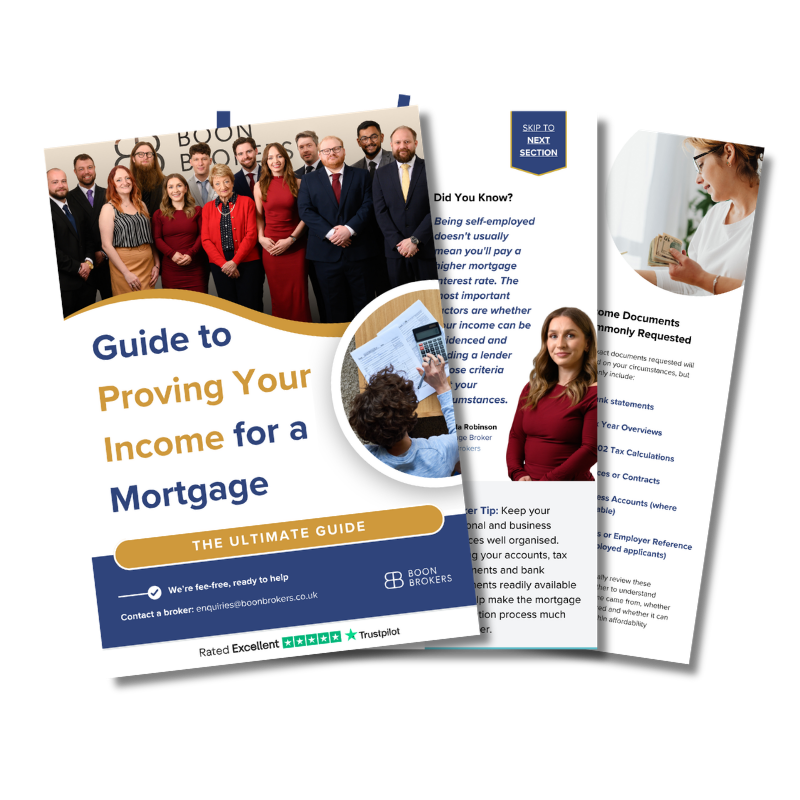
Download Our Free Mortgage Income Guide
Understand lender income requirements and avoid mistakes before applying for your mortgage.
What Is the Minimum Work History for Freelance and Contract Applicants?
Most mainstream mortgage lenders will prefer to see at least two years of trading or contract history, although some lenders will consider applicants with 6-12 months, depending on their criteria and strength of the application.
As all lenders have their own unique criteria, there is no single contract or trading history requirement that applies across all mortgage lenders.
While some lender criteria request to see a longer track record of income, others may be willing to consider applicants with a shorter history, depending on the overall strength of the application and the supporting evidence provided.
How Much Trading History Do Freelancers Need for a Mortgage?
As a general rule, most lenders will require a minimum of two years of trading history for freelancers. This will be supported in the mortgage application through Tax Calculations (SA302), Tax Year Overviews and other financial documents.
When considering how mortgage lenders assess freelance income, one of the main challenges is that earnings do not always arrive in a predictable pattern. There may be periods where business is thriving, followed by quieter months when new projects or contracts are secured.
To mitigate the risk of changing income patterns, lenders will usually want to see a longer trading history for freelancers to accurately assess their affordability.
With that said, there are some lenders who may consider applicants with only one year of trading history. The trade-off here is that mortgage products may be more limited and lenders may ask for additional supporting evidence.
How Much Contract History Do Contractors Need for a Mortgage?
Unlike freelancers, contractors are often assessed based on both their current contract and their wider contracting history.
While the exact contractor mortgage criteria can vary between lenders, many prefer applicants to demonstrate at least 12 months of contracting experience, often with limited gaps between contracts. In this context, a gap will usually refer to a period of more than six weeks between contracts.
In general, lenders are looking to establish that the contract income forms part of an ongoing pattern of work rather than a short-term arrangement.
As such, rather than focusing solely on a single contract that is currently underway, lenders will often consider:
- The length of the current contract
- The time remaining on the contract
- Previous contracts
- Any gaps between contracts
- Industry experience
- Overall earnings history
In some cases, lenders may be willing to consider applicants with a shorter contracting history.
For example, certain lenders may accept contractors who have completed at least six months of a contract arrangement that covers a full 12-month period. However, these situations are not standard practice and will depend on the lender’s specific criteria and approach to affordability assessments.
What Mortgage Deals Are Available?
Freelancers and contractors can apply for most standard mortgage products, including fixed-rate, variable-rate, tracker and buy-to-let mortgages.
One common misconception among freelancers and contractors is that their working arrangement or income structure will limit the types of mortgages available to them. In reality, both freelance and contract workers will have access to all the same mortgage options as a traditional PAYE employee would have.
There are no specific specialist mortgages for freelancers and contractors and the main difference will usually not be the mortgage itself, but simply how lenders assess income and affordability.
To help demonstrate this, the table below outlines some of the most common mortgage options available to freelancers and contractors, along with who they may suit and the potential benefits of each.
Mortgage Options for Freelancers and Contractors
| Mortgage Option | Best For | Key Benefit |
| Residential Mortgage | Buying a main home | Same mortgage products as employed applicants, subject to lender criteria. |
| Buy-to-Let Mortgage | Buying an investment property | Affordability often based on expected rental income. |
| First-Time Buyer Mortgage | Buying your first home | Access to low-deposit and first-time buyer mortgages, where eligible. |
| Home Mover Mortgage | Moving to a new home | Use freelance or contract income to buy your next property. |
| Remortgage | Switching lender or deal | Secure a better rate, release equity or change mortgage terms. |
It’s important to note that freelance mortgage eligibility, contractor mortgage eligibility, and the resulting mortgage approval will always depend on how affordability is assessed by your chosen lender.
For this reason, finding a lender whose criteria aligns with your specific income structure can be just as important as finding the right mortgage product itself.
Get Expert Advice from a Mortgage Broker
Getting advice from a mortgage broker can help freelancers and contractors find lenders that suit their income structure, prepare the right documentation, and improve the chances of a successful mortgage application.
Getting a mortgage as a freelancer or contractor often comes down to choosing the right lender.
While some lenders focus on tax returns and trading history, others place greater emphasis on contracts, day rates, salary and dividends, or retained profits. Expert mortgage advice can help you find the lenders best suited to your income.
This is where working with an expert mortgage broker can help you find the right lender for you.
At Boon Brokers, our expert advisers provide fee-free mortgage advice across the UK. As a whole-of-market mortgage broker, we compare lenders from across the market to help identify those whose criteria are best suited to your income structure and circumstances.
If you’re preparing a mortgage application, our complete guide to proving your income for a mortgage explains the documents lenders require and how affordability is assessed across different types of employment.
Need Mortgage Advice?
Submit an Enquiry
Frequently Asked Questions
Can Freelancers Get the Same Mortgage Rates as Employees?
Yes. Freelancers can usually access the same mortgage products and interest rates as employed applicants. Mortgage rates are primarily based on factors such as your deposit, credit history, loan-to-value ratio and affordability, rather than your employment status.
Can First-Year Freelancers Get a Mortgage?
Yes. While most lenders prefer to see at least two years of trading history, some mortgage lenders will consider first-year freelancers. Applicants with one year of accounts may have fewer lender options, although strong income, relevant industry experience and a larger deposit can improve their chances of approval.
Jack Freestone
I’m an established content writer at Boon Brokers, where I write and publish financial and mortgage-focused content across the UK property and lending marketplace. My work covers topics including first-time buyers, remortgaging, equity release, and wider market developments affecting borrowers. I hold a Master’s degree in English Literature from the University of Bedfordshire, graduating with distinction. Since then, I’ve worked across freelance, agency, and in-house roles, building experience writing across a range of subjects, with a focus on topics that directly affect everyday consumers. Today, my writing focuses on making complex financial topics clearer, more practical, and easier for everyday readers to understand.Related Articles
- What Are the Bank Statement Requirements to Get a Mortgage?
- How Do Self-Employed Applicants Prove Income for a Mortgage?
- What Does My Payslip Need to Show to Get a Mortgage?
- Can I Get a Mortgage with a Signed Employment Contract?
- Can Overtime Income Be Used in a Mortgage Application?
- What Documents Are Needed for a Mortgage in Principle?
- What Happens if You Can’t Prove Income for a Mortgage?
- How Do You Prove Income on a Zero-Hour Contract for a Mortgage?
- Can Bonus and Commission Income Be Used in a Mortgage Application?
- How Is Rental Income Used in Mortgage Applications?
- Can I Use Cash Income in a Mortgage Application?
- How Do Part-Time Workers Prove Income for a Mortgage?
- What Are the Mortgage Income Requirements for Agency Staff?
- Can Mortgage Lenders Consider Multiple Income Streams?