What Happens if You Can’t Prove Income for a Mortgage?

Author: Jack Freestone
Finance Writer at Boon Brokers

Reviewed by: Gerard Boon
Managing Director at Boon Brokers

Estimated Read Time: 5 Minutes
Lenders must verify your income before approving a mortgage, but there are many alternative forms of evidence depending on how you earn your income and their individual lending criteria.
Missing payslips, unfinished accounts, or incomplete income records do not automatically mean your mortgage application will be declined. While lenders must verify your income before approving a mortgage, many will accept alternative evidence depending on your circumstances and their lending criteria.
In this article, we walk you through why lenders require proof of income, what can happen if you’re missing documents, and the steps you can take to move your mortgage forward. Let’s begin.
In this article...
- Why Is Proof of Income Essential for a Mortgage Application?
- What Happens If You Can’t Provide Proof of Income?
- Are There Alternative Ways to Verify Income for a Mortgage?
- Can Specialist Lenders Offer More Flexible Mortgage Criteria?
- What Steps Should You Take Before Reapplying for a Mortgage?
- How Can a Mortgage Broker Help You Find the Right Lender?
- Frequently Asked Questions
Why Is Proof of Income Essential for a Mortgage Application?
Mortgage lenders require proof of income to verify that you can afford your monthly repayments and that your income will reliably continue. This information helps lenders decide how much you can borrow and whether your mortgage is affordable over the long term.
Proof of income is essential because mortgage lenders need to verify that you can afford your monthly repayments both now and throughout the mortgage term.
For some borrowers, proving their income is one of the more challenging parts of the mortgage application process. In fact, Boon Brokers’ research into Mortgage Application Stress found that 21% of borrowers identified proving their income as one of the most stressful stages, highlighting the importance of preparing your income documents before applying.
With that said, there are many different types of documentation that can be requested as part of the income verification process. This will vary depending on the lender’s criteria, your employment type, and income structure.
For example, someone who works in full-time employment may be asked for very different documentation compared to a self-employed applicant, company director, landlord, or retiree.
Below we have listed some of the most common documentation that can be used to provide evidence of your income, including:
- Payslips
- Bank statements
- Employment contracts
- SA302 tax calculations
- Tax Year Overviews
- Company accounts
- Pension statements
- Rental income records
While the supported documentation required can vary between lenders and income types, it’s important to note that the objective for lenders remains the same. These documents are used to determine how much you can borrow and whether your income will be able to support repayments.
Ultimately, proof of income is essential for every mortgage application because it gives the lender the evidence they need to make an informed affordability assessment before approving the mortgage loan.
See What Our Clients Have To Say...
What Happens If You Can’t Provide Proof of Income?
If you cannot provide proof of income, your mortgage application will be rejected. Lenders must verify how much you earn before they can assess affordability and decide whether the mortgage is financially suitable.
Missing one or two documents will not always result in a complete mortgage rejection. Instead, the outcome will usually depend on what evidence is missing, why it cannot be provided, and whether alternative documentation can be used to verify your income.
As a general rule, if any documentation is missing, lenders will usually first ask for more information rather than refuse an application straight away. For example, they may ask for updated bank statements, tax documents, employment evidence, or a written explanation in order to understand how your income is earned.
In some cases, lenders may also use Open Banking in order to verify your financial information. With your permission, Open Banking technology allows lenders to securely access transaction data directly from your bank account, helping them review income, spending habits, and affordability more efficiently.
Depending on the strength of the application, a lender may take several different courses of action while they continue their assessment, including:
- Requesting additional documents to verify your income
- Carrying out further affordability checks
- Delaying the application while further evidence is reviewed
- Reducing your borrowing amount if income cannot be fully verified
- Declining the application if affordability cannot be confirmed
It’s important to note that under the strict Anti-Money Laundering (AML) regulations, lenders are required to understand where funds, such as deposits or savings, have come from – particularly where large sums of money are involved.
Need Help Proving Your Income?
Find lenders that understand your income and the documents you can provide.
Are There Alternative Ways to Verify Income for a Mortgage?
If you cannot provide standard proof of income, lenders may accept alternative evidence instead. This could include employment contracts, Tax Calculations (SA302), Open Banking data, or additional income sources.
Most lenders will initially request standard documentation as proof of income. These include payslips, bank statements, or tax calculations. However, these are not the only forms of evidence that may be accepted.
Lenders are not typically looking for just one specific document. Instead, they are looking for enough reliable evidence that provides them with a complete overview of your financial accounts to verify your income and assess your total affordability with confidence.
Below are some of the most common forms of alternative income verification for mortgage applications that lenders may accept.
Alternative Ways to Verify Income for a Mortgage
| Income Verification Method | Best For | Documentation Required |
| Bank Statements | Self-employed applicants, freelancers, and contractors | Personal and business bank statements showing regular income |
| SA302 Tax Calculations | Self-employed individuals and sole traders | SA302s and HMRC Tax Year Overviews |
| Employment Contract | Applicants starting a new role | Signed employment contract and start date confirmation |
| Rental Income | Landlords and property investors | Tenancy agreements, bank statements, and tax records |
| Dividend Income | Limited company directors receiving dividend income | Dividend vouchers, company accounts, and tax documentation |
| Pension Income | Retired applicants | Pension statements and evidence of regular payments |
| Open Banking | Applicants willing to share banking data digitally | Secure access to transaction history through Open Banking technology |
| Variable Income Evidence | Employees receiving commission, bonuses, or overtime | Payslips demonstrating a track record of additional earnings |
These types of alternative documentation for mortgage affordability can help lenders build a clearer picture of your financial circumstances where traditional proof of income is unavailable or does not accurately reflect your total income.
It’s important to note that each lender has their own criteria and will not accept every type of document listed above. Instead, the key is to find a lender that understands your unique income and financial situation and who will accept the evidence you can provide.
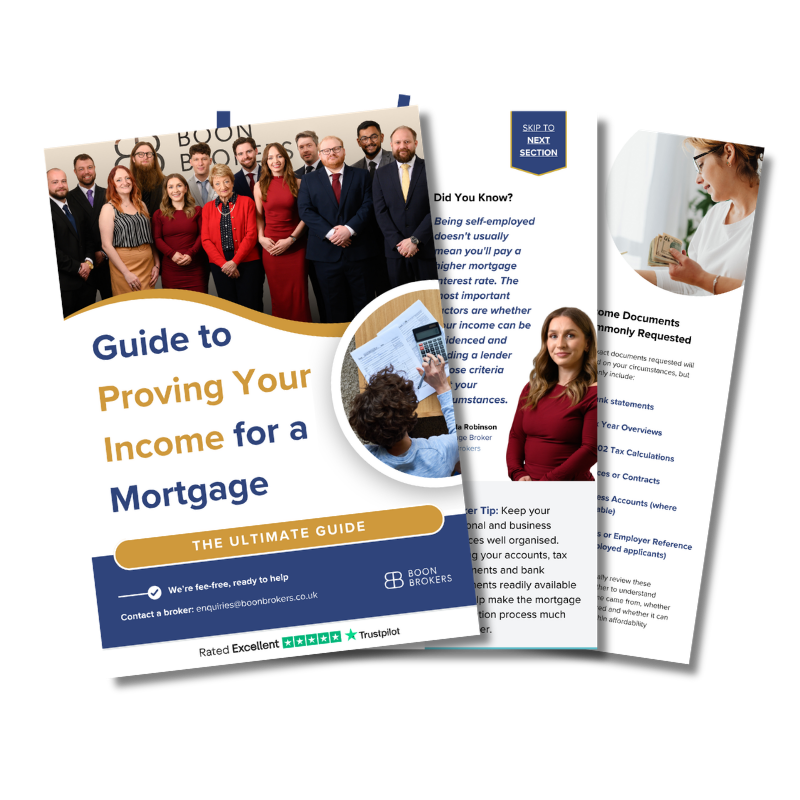
Download Our Free Mortgage Income Guide
Understand lender income requirements and avoid mistakes before applying for your mortgage.
Can Specialist Lenders Offer More Flexible Mortgage Criteria?
Yes. Specialist lenders can often accept a wider range of income sources and supporting documents than some high street lenders.
Specialist lenders can be particularly beneficial if your income is not easily evidenced through standard payslips or traditional employment records.
With that said, a flexible criteria should not be confused with having no proof of income requirements. Specialist lenders will still need to verify your income, however, they can often be more willing to assess non-standard income and alternative supporting evidence when assessing affordability.
Specialist lenders may be a suitable option if you are:
- Self-employed applicants
- Company directors
- Contractors and freelancers
- Landlords with rental income
- Applicants with multiple income streams
- Individuals who want to include commission, bonuses, or overtime income
Ultimately, specialist lenders are not offering a way around income verification. Instead, they can potentially help borrowers whose income falls outside traditional lending criteria access mortgage options that may otherwise be difficult to secure.

What Steps Should You Take Before Reapplying for a Mortgage?
Before reapplying for a mortgage, find out why your application was unsuccessful, gather the correct proof of income, and check whether alternative evidence may be accepted.
If your mortgage application has been declined, it does not mean that you cannot get a mortgage. While a rejected mortgage application can feel like a major setback, there are plenty of practical steps you can take to strengthen your position before applying again.
Our top tip when it comes to reapplying is to take a step back and evaluate exactly why your mortgage was rejected in the first place.
Whether the issue was a mortgage declined due to income verification concerns, affordability concerns, credit history, or lender criteria, reapplying too quickly without understanding the cause will only increase the risk of another rejection.
Let’s take a look at the 5 steps you should take before reapplying for your mortgage:
Step 1: Understand Why the Application Was Declined
The most important step is to start by finding out exactly why the lender was unable to proceed. Was a document missing? Was your income too recent? Did the lender refuse to accept a particular income source?
Understanding the specific reason for the mortgage rejection can highlight exactly what you might need to change, helping you avoid repeating the same issue with another lender.
Step 2: Gather and Update Your Income Documents
Next, take the time to prepare your mortgage and income documents before submitting a new mortgage application. Gather all the documents that are needed to support your income. This may include payslips, bank statements, Tax Calculations (SA302), Tax Year Overviews, company accounts, dividend evidence, rental income records, or pension statements.
Taking the time to check your chosen lender’s criteria and organise these documents in advance can make the application process far smoother and help ensure that your income can be assessed correctly from the start.
Step 3: Check Whether Alternative Evidence Is Available
If you cannot provide the exact documents that are requested, consider whether another form of evidence could verify the same income. For example, bank statements, employment contracts, Open Banking, accountant references, or tax documents may help support the application depending on the lender’s criteria.
If you’re working with a trusted mortgage broker – like Boon Brokers – your dedicated adviser will be able to liaise with your lender to narrow down exactly which alternative forms of evidence may be accepted
Step 4: Review Your Wider Financial Position
Providing evidence of your income is only one part of a lender’s affordability assessment. Before reapplying, it can also be extremely beneficial to check your credit file, review regular spending, and reduce unnecessary borrowing where possible.
While each of these steps may seem relatively small on their own, together they can help strengthen your application and play an important role in improving mortgage approval chances after a rejection.
Step 5: Speak to a Mortgage Broker Before Applying Again
Finally, speaking to a mortgage broker before reapplying can help you avoid repeating the same mistakes. A trusted mortgage broker can take a complete view of your case, reviewing your circumstances, identifying why the application was unsuccessful, and can provide support in the areas that you need.
How Can a Mortgage Broker Help You Find the Right Lender?
A mortgage broker can identify lenders whose affordability criteria match your income and advise which proof of income documents are most likely to be accepted. This can improve your chances of applying with the right lender for the first time and help avoid unnecessary delays or declined applications.
Finding the right lender will often be just as important as providing the right proof of income. Working with a trusted whole-of-market mortgage broker can help you identify lenders whose criteria are better suited to your circumstances, ensuring your income is assessed by a lender that understands how your income is earned and evidenced.
At Boon Brokers, our dedicated mortgage advisers regularly help applicants whose income falls outside standard employment arrangements. Whether you are self-employed, receive income from multiple sources, or need guidance on alternative forms of income evidence, our experts are here to help you understand your options and identify lenders whose criteria match your circumstances.
For more information on how lenders assess income, read our complete guide on what proof of income is needed for a mortgage to learn which documents lenders will request, how different income types are assessed, and how to prepare your application with confidence.
Need Mortgage Advice?
Submit an Enquiry
Frequently Asked Questions
Can Bank Statements Replace Payslips for a Mortgage?
Bank statements can be used alongside other documents to help verify your income, but they do not usually replace payslips on their own. Lenders will often request additional evidence, such as employment contracts, tax documents, or company accounts, depending on how you earn your income.
Will a Mortgage Be Declined Without Proof of Income?
Yes. If a lender cannot verify your income using standard or alternative evidence, your mortgage application is likely to be declined because they cannot complete their affordability assessment.
Can Self-Employed People Get a Mortgage Without Payslips?
Yes. Self-employed applicants do not usually have payslips, so lenders will instead verify income using documents such as Tax Calculations (SA302), Tax Year Overviews, company accounts, and bank statements.
Jack Freestone
I’m an established content writer at Boon Brokers, where I write and publish financial and mortgage-focused content across the UK property and lending marketplace. My work covers topics including first-time buyers, remortgaging, equity release, and wider market developments affecting borrowers. I hold a Master’s degree in English Literature from the University of Bedfordshire, graduating with distinction. Since then, I’ve worked across freelance, agency, and in-house roles, building experience writing across a range of subjects, with a focus on topics that directly affect everyday consumers. Today, my writing focuses on making complex financial topics clearer, more practical, and easier for everyday readers to understand.Related Articles
- What Are the Bank Statement Requirements to Get a Mortgage?
- How Do Self-Employed Applicants Prove Income for a Mortgage?
- What Does My Payslip Need to Show to Get a Mortgage?
- Can I Get a Mortgage with a Signed Employment Contract?
- Can Overtime Income Be Used in a Mortgage Application?
- How Do You Prove Income on a Zero-Hour Contact for a Mortgage?
- Can Bonus and Commission Income Be Used in a Mortgage Application?
- What Are the Mortgage Income Requirements for Freelancers and Contractors?
- How Is Rental Income Used in Mortgage Applications?
- Can I Use Cash Income in a Mortgage Application?
- How Do Part-Time Workers Prove Income for a Mortgage?
- What Are the Mortgage Income Requirements for Agency Staff?
- Can Mortgage Lenders Consider Multiple Income Streams?