How Do Self-Employed Applicants Prove Income for a Mortgage?

Author: Jack Freestone
Finance Writer at Boon Brokers

Reviewed by: Gerard Boon
Managing Director at Boon Brokers

Estimated Read Time: 5 Minutes
Self-employed applicants need to provide their Tax Year Overviews, Tax Calculations (SA302), business accounts, and bank statements, for lenders to verify their income and assess affordability.
Even when your income is strong and your business is performing well, lenders may still require extra documentation to complete a more detailed affordability check before making a decision.
In this article, we explain exactly how lenders will assess self-employed income, which documents will be required, and how you can improve your chances of getting a mortgage approved. Let’s jump in.
In this article...
- Why Are Self-Employed Mortgage Applications Assessed Differently?
- What Key Documents Do Self-Employed Mortgage Applicants Need to Provide?
- How Many Years of Income History Are Required for a Mortgage?
- How Do Lenders Calculate Self-Employed Income?
- What Are the Best Tips to Improve Your Self-Employed Mortgage Approval Chances?
- Should I Talk to a Mortgage Broker Before Applying for a Mortgage?
- Frequently Asked Questions
Why Are Self-Employed Mortgage Applications Assessed Differently?
Self-employed mortgage applications are assessed differently because the income from self-employed work can often fluctuate, requiring lenders to carry out additional affordability and income checks.
The main differences in mortgage approval for self-employed borrowers comes down to how lenders assess mortgage affordability. This is simply because self-employed income is structured very differently from a standard employed salary.
For employed applicants, lenders can usually rely on fixed monthly payslips. However, for self-employed applicants, the income can often fluctuate throughout the year depending on contracts, client demand, or general business performance.
To counteract this fluctuation, lenders will typically request additional documentation to allow for a more accurate insight into how much income is earned annually. This includes assessing the overall financial position of the business and determining whether the income appears to be sustainable long-term.
In practice, this means that lenders will not focus on one specific month in isolation. Instead, they will review a list of documents including Tax Calculations (SA302) and Tax Year Overviews from the last 2-3 years. Additional documents that lenders can request could include:
- Year-on-year income
- Business bank statements
- Existing financial commitments
- Retained company profits
- Signs of declining or irregular income
Boon Brokers’ 2026 research into the stresses of completing a mortgage application found that 28% of respondents identified finding the best mortgage deal as one of the most stressful parts of the mortgage application process.
For self-employed applicants, this highlights the importance of preparing the correct documentation and finding a lender whose affordability criteria match your income structure.
See What Our Clients Have To Say...
What Key Documents Do Self-Employed Mortgage Applicants Need to Provide?
The key documents required for a self-employed mortgage application are Tax Calculations (SA302), Tax Year Overviews, business accounts, bank statements, proof of identity, and proof of address.
The required documentation for self-employed mortgage applicants can vary slightly between lenders, depending on their specific criteria. However, the core paperwork that is requested will generally be the same across the wider market.
To help, we have created an overview of the most commonly required documents for self-employed mortgage applications:
Common Documents for Self-Employed Applicants
| Category | Document Name | How the Document Can Help Lenders |
| HMRC Tax Records | Tax Calculation/SA302 | Shows declared taxable income and tax calculations submitted to HMRC |
| HMRC Verification | Tax Year Overview | Confirms submitted tax figures match HMRC records |
| Business Accounts | Finalised Accounts | Demonstrates business performance, profit, and stability |
| Bank Records | Business Bank Statements | Shows incoming revenue, trading activity, and cash flow |
| Bank Records | Personal Bank Statements | Helps lenders assess spending habits and monthly commitments |
| Director Specific | P60 and Payslips | Confirms employed salary for limited company directors |
| Proof of Identity | Passport or Driving Licence | Verifies identity and residency rights |
| Proof of Address | Utility Bill or Council Tax Statement | Confirms current UK address |
For self-employed applicants, the two main documents required for a mortgage application will be Tax calculations (SA302) and Tax Year Overviews. This is because the Tax Calculations must be completed through HMRC and can provide lenders with a direct summary of taxable income.
Get Free Self-Employed Mortgage Advice
Find out which lenders best match your self-employed income.
How Many Years of Income History Are Required for a Mortgage?
Most self-employed applicants will need at least two years of accounts or tax returns to apply for a mortgage, however, there are lenders that accept just one year of trading history in certain circumstances.
As all lenders have their own assessment criteria, the minimum amount of years of self-employed income required for a mortgage will vary between providers. However, as a general rule, a minimum of two years of accounts will allow access to a wide-range of mortgage options.
With that said, a newly self-employed applicant with only one year of accounts can still get a mortgage. While it will be more difficult for lenders to assess, there are lenders who have a more flexible lending criteria for applicants that can still demonstrate strong industry experience, ongoing contract work, healthy savings, or a larger deposit.

Case Study
- Problem: Ryan recently became self-employed and on completing a financially strong first trading year, he wanted to apply for a mortgage with only one full year of accounts.
- Solution: By working with a whole-of-market mortgage broker, Ryan was matched with lenders that considered applicants with shorter trading histories and was able to find a mortgage.
Lenders will look closely at how income has changed over recent tax years when assessing affordability. As such, it is general practice for lenders to average income across the last two or three years to establish a more realistic picture of an applicant’s ongoing annual earnings.
In cases where profits have increased steadily over time, some lenders may choose to work the affordability calculations on the latest year’s figures instead. Conversely, if accounts show a more recent decline in profits, lenders may choose to use the lower income figure or average the reduced earnings to help mitigate their risk.
How Do Lenders Calculate Self-Employed Income?
For self-employed applicants, lenders will usually calculate income using the net profit declared on Tax Calculations, or salary and dividends for limited company directors.
Different business structures generate income in different ways, which is why lenders do not use a single method when calculating self-employed income. Instead, the way your income is assessed will depend on whether you are a sole trader, limited company director, freelancer, contractor, or business partner.
Sole Traders
For sole traders, mortgage lenders will usually calculate affordability using the net profit declared on your Tax calculations (SA302) or Tax Year Overviews rather than your business turnover. Because turnover does not reflect your actual income after expenses, lenders focus on the profit available to support your mortgage repayments.
Limited Company Directors
Limited company directors are often assessed slightly differently and will depend on your chosen lender. For example, some lenders will use salary plus dividends, while others may also consider retained profits left within the business.
Freelancers, Contractors, and Partnerships
Freelancers, contractors, and business partnerships may each be assessed using different methods depending on how their income is earned and evidenced. The exact approach will vary between lenders and is often influenced by factors such as contract arrangements, trading history, tax records, and business structure.
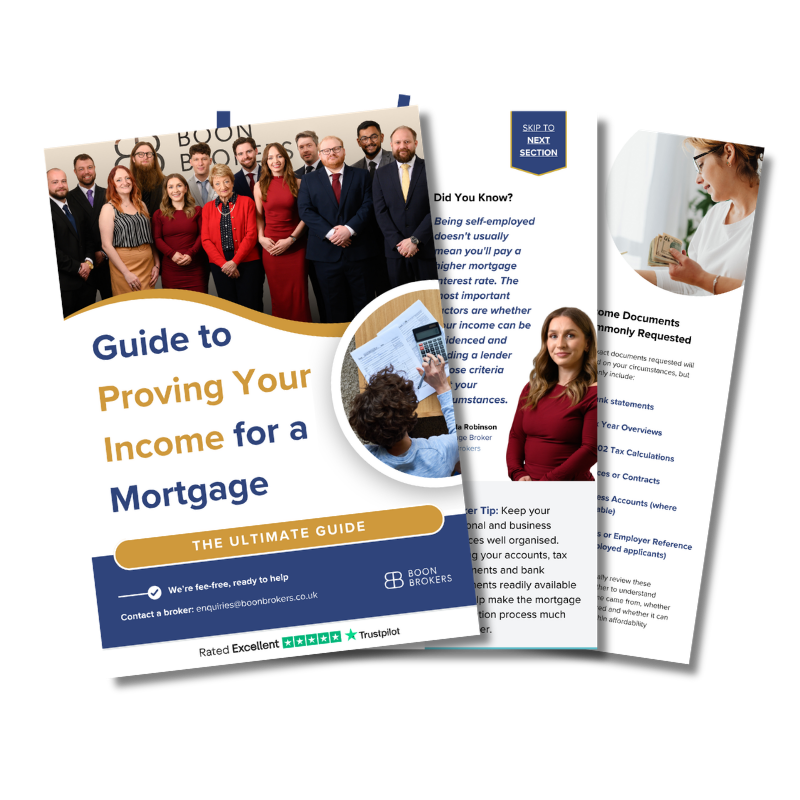
Download Our Free Mortgage Income Guide
Understand lender income requirements and avoid mistakes before applying for your mortgage.
What Are the Best Tips to Improve Your Self-Employed Mortgage Approval Chances?
The best way to improve your self-employed mortgage approval chances is to prepare your finances early, maintain organised financial records, demonstrate stable income, and apply with a lender whose criteria matches your income structure.
One of the biggest mistakes self-employed applicants can make is waiting to review their finances just a few weeks before applying for a mortgage.
While it might not sound like the most thrilling activity, the reality is that the strongest applications are often prepared months in advance, planned to provide lenders with a clear picture of income, affordability, and financial stability.
And so it is with no surprise that one of the most effective ways of improving a self-employed mortgage application is to ensure that all accounts, tax records, and bank statements are accurate, organised, and fully up to date before applying.
Any missing documents, overdue tax returns, or inconsistent financial activity can all slow down the underwriting process unnecessarily.
Here are the most effective ways self-employed applicants can improve their chances of mortgage approval:
- Separate business and personal finances clearly
- File tax returns on time and keep accounts current
- Reduce overdraft usage where possible
- Avoid taking on unnecessary debt before applying
- Maintain a stable pattern of income where possible
Preparing early, maintaining clear financial records, and understanding how your income will be assessed can all play an important role in strengthening a self-employed mortgage application.

Should I Talk to a Mortgage Broker Before Applying for a Mortgage?
Yes. A mortgage broker can help identify lenders whose affordability criteria are better suited to self-employed income structures and can often access more mortgage products on the market.
While self-employed applicants often have a few more hoops to jump through during the mortgage process, understanding how lenders assess your income and preparing the right supporting documents can make the journey much more straightforward.
One of the biggest challenges for many self-employed applicants is that lender criteria can vary significantly from one provider to another, and this is where speaking to a whole-of-market mortgage broker can make a real difference.
Remortgaging when self-employed can also involve additional income checks, particularly if your earnings or business structure have changed since your original mortgage application.
Whether you are newly self-employed, an established company director, or working across freelance and contract-based income, Boon Brokers can help you explore the mortgage options that match your needs.
For more information, read our complete guide on what proof of income is needed for a mortgage and learn the A-Z on how lenders verify different types of income, the documents they request, and how to prepare for a mortgage application.
Need Mortgage Advice?
Submit an Enquiry
Frequently Asked Questions
How Strict Are Mortgage Checks for the Self-Employed?
Mortgage checks for self-employed applicants usually require more evidence because lenders need to verify a more complex income structure to assess affordability. Rather than relying on payslips alone, lenders will assess tax records, business accounts, and bank statements.
Do I Need 2 or 3 Years of Accounts for a Mortgage?
Most lenders’ criteria will require two years of accounts or tax returns, however, some will consider applicants with one year of trading history. Having evidence of a successful and longer trading history can provide access to a wider range of mortgage lenders and products.
Can I Apply for a Mortgage With One Year of Self-Employed Income?
Yes, some lenders will consider applicants with one year of self-employed income once a completed tax return is available. However, mortgage options are likely to be more limited than for applicants with a longer trading history.
Jack Freestone
I’m an established content writer at Boon Brokers, where I write and publish financial and mortgage-focused content across the UK property and lending marketplace. My work covers topics including first-time buyers, remortgaging, equity release, and wider market developments affecting borrowers. I hold a Master’s degree in English Literature from the University of Bedfordshire, graduating with distinction. Since then, I’ve worked across freelance, agency, and in-house roles, building experience writing across a range of subjects, with a focus on topics that directly affect everyday consumers. Today, my writing focuses on making complex financial topics clearer, more practical, and easier for everyday readers to understand.Related Articles
- What Are the Bank Statement Requirements to Get a Mortgage?
- What Does My Payslip Need to Show to Get a Mortgage?
- Can I Get a Mortgage with a Signed Employment Contract?
- Can Overtime Income Be Used in a Mortgage Application?
- What Happens if You Can’t Prove Income for a Mortgage?
- How Do You Prove Income on a Zero-Hour Contact for a Mortgage?
- Can Bonus and Commission Income Be Used in a Mortgage Application?
- What Are the Mortgage Income Requirements for Freelancers and Contractors?
- How Is Rental Income Used in Mortgage Applications?
- Can I Use Cash Income in a Mortgage Application?
- How Do Part-Time Workers Prove Income for a Mortgage?
- What Are the Mortgage Income Requirements for Agency Staff?
- Can Mortgage Lenders Consider Multiple Income Streams?