Can I Use Cash Income in a Mortgage Application?

Author: Jack Freestone
Finance Writer at Boon Brokers

Reviewed by: Gerard Boon
Managing Director at Boon Brokers

Estimated Read Time: 5 Minutes
Yes. Cash income can be used for a mortgage application if it can be verified through appropriate supporting evidence and meets a lender’s affordability criteria.
We’ve all heard the phrase “Cash is King”, but can it secure you a mortgage?
Many lenders are willing to accept cash earnings where it can be properly evidenced. However, because cash earnings do not always have the same documentation as income paid through a standard payroll system, lenders will often carry out additional checks before including it within their affordability assessments.
In this article, we walk you through exactly how lenders assess cash-based earnings, when cash can be used for a mortgage application, and what evidence you’ll need to support your mortgage application. Let’s begin.
Can You Use Cash Earnings in a Mortgage Application?
Mortgage lenders will only accept cash income within a mortgage application if it can be properly evidenced. This will usually involve demonstrating that the income has been declared to HMRC where required, taxed appropriately, and supported by records.
Being paid in cash is not usually a problem. The challenge is proving that the income is legitimate, consistent, and can reasonably be expected to continue in the future.
In reality, a lender will be less concerned about “how” you were paid and more concerned about whether the income can be evidenced through the appropriate documentation, properly declared, and ultimately relied upon when assessing affordability.
A common self-employed scenario would be a plumber who is regularly paid in cash by customers. Provided those earnings are deposited, recorded, and declared to HMRC, many lenders may still be willing to consider that income as part of a mortgage application.
By contrast, cash earnings that have never been declared or cannot be supported by documentation simply won’t be considered by most lenders.
The bottom line is that a lender’s main focus is to assess whether the income can be relied upon to support ongoing mortgage repayments. The stronger the evidence, the more likely the income is to be included within affordability assessments.
See What Our Clients Have To Say...
How Can You Evidence Cash Earnings for a Mortgage?
Cash earnings will usually need to be evidenced through a combination of supporting documents, including bank statements, payslips, HMRC records, tax documents, business accounts, and invoices.
The most effective way of proving income for a mortgage is to build a record of exactly where those earnings came from, how regularly they have been received, and provide evidence that all income has been properly declared.
It’s important to note that there is no single document that can achieve this. Instead, lenders are looking for a chain of evidence that provides a full picture of your financial position and supports the income being used within the mortgage application.
Rather than relying on a single document, lenders will usually require a combination of supporting documents as proof of cash income for mortgage applications, including:
- Bank statements showing regular cash deposits
- Tax Calculations (SA302)
- Tax Year Overviews
- Self-employed accounts
- Payslips
- Invoices and contracts
- Accountant certificates
For self-employed applicants, lenders will usually request tax documentation as evidence of the total income that has been formally declared to HMRC.
For employed applicants who receive part of their earnings in cash, lenders will assess supporting documents for consistency between payslips, bank statements, and employment records.
To see how this works in practice, let’s take a look at two examples. The first shows an applicant with strong evidence of their cash income, while the second highlights some of the challenges that can arise when evidence is limited:
Example 1: Strong Income Evidence
A self-employed electrician has spent several years completing domestic and commercial work. Many customers pay in cash, but every payment is deposited into a business bank account and properly recorded in the following way:
- Receives cash from customers
- Deposits the cash into their business account
- Issues invoices
- Declares the income to HMRC
- Has SA302s and Tax Year Overviews
In this example, the lender can follow the income from receipt through to declaration, giving them multiple sources of evidence to verify affordability.
Example 2: Limited Income Evidence
A freelancer regularly receives cash payments for completed work and occasionally deposits the money into their bank account. However, they do not keep regular records and have not formally declared the income:
- Regularly deposits £500 – £1,000 cash each month
- Has no invoices
- Has not declared the income
Here, the bank statements show money entering the account, but they do not necessarily demonstrate the source of the income or whether it can be used within affordability calculations. Ultimately, this would be viewed as undocumented income and lenders would likely not accept this within their affordability assessment.
Get Expert Mortgage Advice
Find lenders that accept cash income and tips. Start your application journey here.
Why Do Lenders View Cash Income as a Risk?
Lenders view cash income as a higher risk because it does not always have a clear financial paper trail. Without sufficient evidence, it can be harder to verify, assess for affordability, and include within a mortgage application.
Unlike a salary that is paid by an employer under an employment contract and processed through a payroll system, cash payments do not create the same chain of evidence that lenders typically rely on when assessing affordability and risk.
With that said, this does not mean that cash earnings cannot be used to secure a mortgage. Rather, it simply explains exactly why lender will often carry out additional checks on documentation and income consistency – it’s not just the “cash” itself.
The table below highlights some of the key factors lenders may consider when assessing cash-based income as part of a mortgage application.
Assessment Checks and Their Impact on a Mortgage Application
| What Lenders Check | Impact on a Mortgage Application |
| Evidence of Income | Without sufficient supporting evidence, lenders may not accept the income. |
| Income Consistency | Irregular income may reduce how much you can borrow. |
| Tax Declaration | Income that hasn’t been declared where required is unlikely to be accepted. |
| Source of Income | Lenders may request further evidence to verify where the money came from. |
| Large Cash Deposits | Unusual deposits may result in additional checks and delays. |
The good news is that many of these concerns can be addressed by being prepared and submitting the right evidence with your application.
Consistent bank deposits, tax records, invoices, and other supporting documents will all help lenders understand how the income is earned and whether it can be relied upon when assessing affordability.
How Should You Properly Declare Cash Income?
Mortgage lenders assess income that has been properly declared and can be supported by appropriate evidence. If you’re employed, cash earnings are reported through your employer’s PAYE payroll. If you’re self-employed, cash income needs to be declared through a Self Assessment tax return.
Documents Commonly Used to Verify Declared Income
| Employment Type | Common Supporting Documents |
| Employed | Payslips, P60 and bank statements showing cash deposits. |
| Self-employed | Tax Calculations (SA302), Tax Year Overviews, business accounts and bank statements. |
| Limited Company Director | Salary records, dividend vouchers, company accounts and tax documents. |
A common misunderstanding is that regularly depositing cash into a bank account automatically makes that income acceptable for a mortgage application. While bank statements can help show income patterns, lenders will need supporting evidence that the money has been properly declared and can be linked to a legitimate source of earnings.
This is particularly important when reporting cash earnings for mortgage approval. If your bank statements show regular cash deposits but your tax records do not reflect the same level of income, the lender may ask further questions or decide not to include that income within affordability calculations.
Ultimately, taking the time to keep invoices, receipts, accounts, bank records, and tax documentation organised will put you in the best position to provide lenders with the evidence they need to assess your mortgage application.
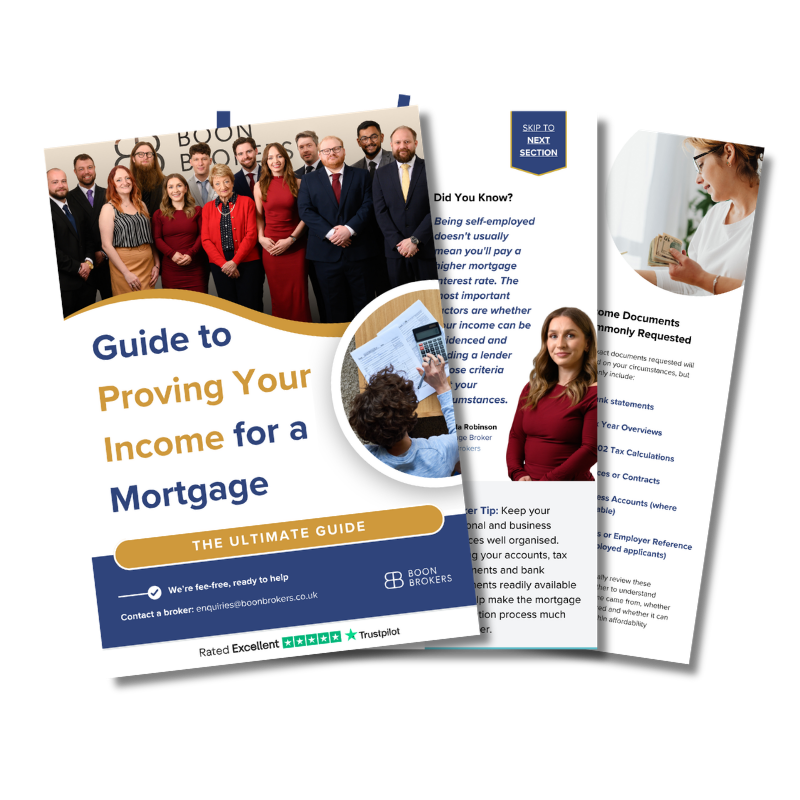
Download Our Free Mortgage Income Guide
Understand lender income requirements and avoid mistakes before applying for your mortgage.
Need Help Applying for a Mortgage When You Are Paid in Cash?
Applying for a mortgage with cash income can be more challenging because lenders often require additional evidence. A mortgage broker can help identify suitable lenders, ensure your documentation meets their criteria, and improve your chances of approval.
Applying through a mortgage broker can be particularly beneficial if you receive cash income, as lender criteria can vary significantly. From tax records and accounts to invoices, payslips, and HMRC documentation, knowing which documents match a lender’s criteria can be challenging.
At Boon Brokers, our dedicated fee-free mortgage advisers help take the guesswork out of the mortgage process. With whole-of-market access, we can compare lenders and mortgage products from across the wider market to identify those most likely to consider your individual circumstances and income profile.
Whether you are self-employed, receive cash tips, or earn part of your income through cash payments, our dedicated mortgage experts can help identify lenders whose criteria are best suited to your circumstances and guide you through the application process from start to finish.
Every mortgage application is different and cash income is just one of several income types that mortgage lenders may assess. Understanding the wider proof of income needed for a mortgage can help you prepare the right documentation before applying and reduce the likelihood of delays.
Need Mortgage Advice?
Submit an Enquiry
Frequently Asked Questions
Can I Use Cash in a Mortgage Application?
Yes, cash income can be used for a mortgage application as long as it has been declared to the HMRC and meets a lender’s criteria. Whether you are employed or self-employed, lenders will usually assess whether the income is consistent, documented, and can be relied upon for affordability.
How Many Years of Cash Earnings Do Lenders Require?
There is no minimum number of years of cash income required by all lenders. Requirements will vary depending on your employment type and the lender’s criteria.
Does Deposited Cash Count as Mortgage Income?
No. Depositing cash into a bank account does not automatically make it mortgage income. Lenders will require evidence showing the source of the money and whether it has been properly declared to the HMRC before including it within affordability assessments.
How Can I Verify Cash Income for a Mortgage?
Cash income is verified using supporting documents that evidence where the income came from and whether it has been properly declared. Depending on your application, lenders may request bank statements, payslips, tax records, accounts, invoices, or employer confirmation.
Do Mortgage Lenders Accept Cash-in-Hand as Proof of Income?
Yes, some lenders will accept cash-in-hand income if it has been properly declared and can be evidenced. However, undeclared cash income will not be accepted because lenders must verify affordability using reliable supporting documentation.
Jack Freestone
I’m an established content writer at Boon Brokers, where I write and publish financial and mortgage-focused content across the UK property and lending marketplace. My work covers topics including first-time buyers, remortgaging, equity release, and wider market developments affecting borrowers. I hold a Master’s degree in English Literature from the University of Bedfordshire, graduating with distinction. Since then, I’ve worked across freelance, agency, and in-house roles, building experience writing across a range of subjects, with a focus on topics that directly affect everyday consumers. Today, my writing focuses on making complex financial topics clearer, more practical, and easier for everyday readers to understand.Related Articles
- How Do Self-Employed Applicants Prove Income for a Mortgage?
- Can I Get a Mortgage with a Signed Employment Contract?
- Can Overtime Income Be Used in a Mortgage Application?
- What Happens if You Can’t Prove Income for a Mortgage?
- How Do You Prove Income on a Zero-Hour Contract for a Mortgage?
- Can Bonus and Commission Income Be Used in a Mortgage Application?
- What Are the Mortgage Income Requirements for Freelancers and Contractors?
- How Is Rental Income Used in Mortgage Applications?
- How Do Part-Time Workers Prove Income for a Mortgage?
- What Are the Mortgage Income Requirements for Agency Staff?
- Can Mortgage Lenders Consider Multiple Income Streams?