Can Mortgage Lenders Consider Multiple Income Streams?

Author: Jack Freestone
Finance Writer at Boon Brokers

Reviewed by: Gerard Boon
Managing Director at Boon Brokers

Yes. Many mortgage lenders will accept multiple income streams when assessing affordability, provided each income source can be verified and meets the lender’s criteria.
While many lenders are happy to consider additional income from freelance work, second jobs, overtime, dividends, or rental properties, each lender will have their own criteria and they won’t always assess every income source in the same way.
Some incomes could be fully included, others may be limited, and any irregular income can sometimes be dismissed altogether. All of which asks the question: What income streams will lenders consider?
In this article, we walk through exactly how lenders assess mixed income, what proof of income will be required, and which income strategies can help strengthen your mortgage application. Let’s begin.
- What Counts as Multiple Income Streams for a Mortgage Application?
- Can You Combine Different Incomes for a Mortgage?
- What Documents Are Required for Each Income?
- How Do Mortgage Lenders Assess Multiple Income Types?
- Tips to Improve Your Mortgage Chances with Multiple Incomes
- Speak to a Mortgage Specialist
- Frequently Asked Questions
What Counts as Multiple Income Streams for a Mortgage Application?
Multiple income streams can include any combination of regular earned or passive income. This may include a second job, freelance work, overtime, commission, dividends, or rental income.
Using multiple income streams in a mortgage application simply means submitting more than one source of income to support your affordability. This could be two employed jobs, a salary combined with freelance work, self-employed income alongside rental income, or any other combination of regular earnings.
Many lenders are willing to consider a wide range of different income sources. The key is that each income stream can be evidenced and has been received consistently enough to demonstrate that it forms a reliable part of your overall income.
What qualifies as an accepted income source for mortgage affordability will ultimately depend on how the income is earned and whether it meets the lender’s affordability criteria, which we’ll look at in more detail later in this guide.
See What Our Clients Have To Say...
Can You Combine Different Incomes for a Mortgage?
Yes. Many mortgage lenders will combine your salary with any additional or passive income when assessing your total mortgage affordability.
A key consideration to keep in mind is that when assessing applicants who are combining salary and other “side hustle” income in their mortgage application, lenders will focus on the history and reliability of the income sources.
Some examples of multiple income sources lenders may consider include:
- Freelance or self-employed earnings
- Overtime and commission
- Second jobs
- Rental income
- Dividend payments
- Investment income
- Tutoring or consultancy work
- Online business income
As we touched on earlier, additional income that falls outside of the usual standard salaried role will generally require supporting evidence that demonstrates where the income comes from, how reliable it is, and whether it’s likely to continue long term.
Not sure which lenders may consider all of your income? Speak to a fee-free mortgage adviser.
What Documents Are Required for Each Income?
The documents required depend on how each income is earned, but will typically include payslips, bank statements, tax documents, or business accounts.
Depending on the type of additional income that is included, lenders may ask for documents such as:
- Payslips and employment contracts for employed income
- SA302s or tax calculations for self-employed earnings
- Business accounts for company directors
- Tenancy agreements for rental income
- Dividend vouchers for company dividends
While the exact proof of income documents for multiple income streams will vary depending on both the lender and the type of income involved, understanding why this additional documentation is required can help you prepare for the mortgage application process more effectively.
In Boon Brokers’ 2026 research on mortgage application stress, the data revealed that 17% of respondents found unexpected document requests to be one of the most stressful experiences of applying for a mortgage.
As such, while the exact proof of income documents for multiple income streams will vary depending on both the lender and the type of income involved, understanding the reason behind the need for additional documentation can help you prepare for the mortgage application process more effectively.
Ultimately, the additional supporting documents are there to help lenders build a clearer picture of your overall finances, minimise lending risk, and understand what level of income can realistically be relied upon long term.
Where income fluctuates from month to month, lenders will usually look at broader income patterns rather than relying on one particularly high or low month.
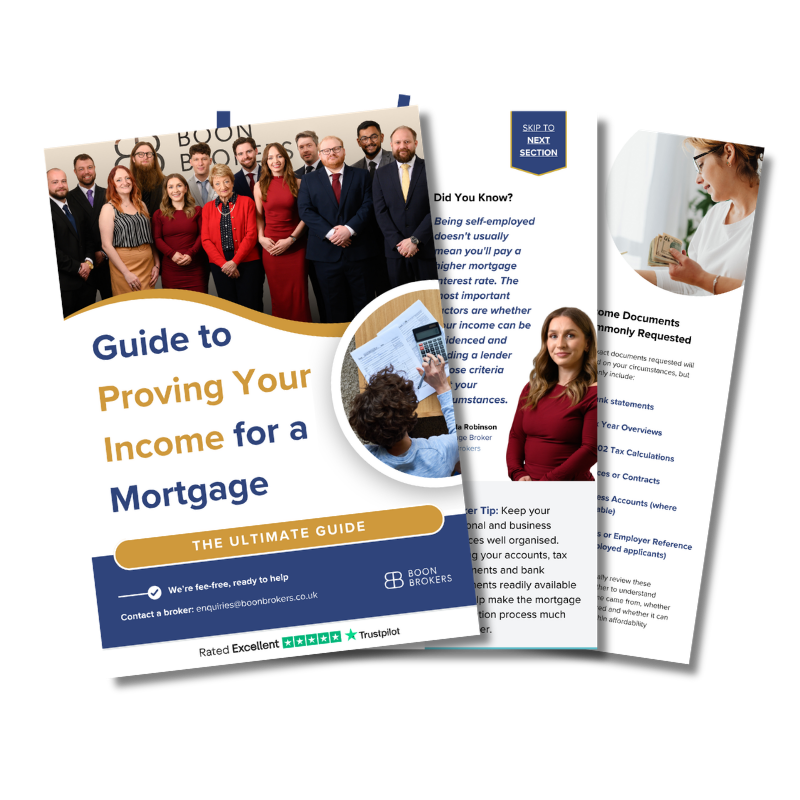
Download Our Free Mortgage Income Guide
Understand lender income requirements and avoid mistakes before applying for your mortgage.
How Do Mortgage Lenders Assess Multiple Income Types?
Mortgage lenders assess each income source individually, using its consistency, reliability, and supporting evidence to determine how much can be included within affordability calculations.
When assessing affordability, mortgage lenders are trying to answer one simple question: “How sustainable is the income being used to support the application?”
The easy way to understand this is to think of patterns. To lenders, the easier an income source is to evidence and the longer it has been received consistently, the more likely they will allow it within your affordability calculations.
It’s important to keep in mind that, even with supporting documentation, how each income stream is assessed will still depend on the lender’s individual criteria.
To help simplify things, we’ve included a general overview below of how different income types are commonly viewed during mortgage affordability assessments.
| Income Category | Income Type | How Lenders Assess Income |
| Primary Income | Main employed or self-employed income | Usually assessed in full using standard income evidence. |
| Secondary Income | Overtime, commission, freelance work, or second jobs | Assessed on consistency, history, and sustainability. |
| Passive Income | Rental income, dividends, or investment earnings | Assessed using supporting financial and tax evidence. |
Ultimately, some lenders may use 100% of overtime or commission within affordability calculations, while others may only include part of the income or average earnings across several months. It is these differences in how lenders view different incomes that can have a massive impact on your total affordability.
Tips to Improve Your Mortgage Chances with Multiple Incomes
The best way to improve your mortgage chances with multiple incomes is to clearly evidence each income stream and apply with a lender whose affordability criteria suits your circumstances.
The keystone to any mortgage application strategy is preparation. When applying with multiple income streams, preparation can make a significant difference to how smoothly your mortgage application progresses.
As we’ve highlighted throughout, the main objective of lenders when it comes to assessing income is to build a clear and reliable picture of your finances. This is much much easier when all documents relating to income are organised and properly evidenced from the start.
Below we have outlined our top 3 tips to help strengthen your mortgage application using multiple incomes:
1) Make Your Income Easy to Follow
When there are multiple income streams involved, keeping your finances organised can make a big difference during the mortgage process. Separating personal and business finances, and maintaining clear income records can all help lenders assess affordability more efficiently.
2) Try to Avoid Sudden Income Changes
Where additional income fluctuates significantly from month to month, lenders may look more closely at how sustainable the earnings appear over time. Sudden drops in freelance income, overtime, or commission shortly before applying can sometimes affect affordability calculations, particularly where lenders rely on recent income averages.
3) Work With a Broker That Understands Multiple Income
Choosing the right lender can make all the difference when applying with multiple income streams, especially where additional income is needed to strengthen affordability.

Speak to a Mortgage Specialist
Applying for a mortgage with multiple income streams can be difficult, especially when you’re unsure what the income criteria is for your chosen lender.
If you’re planning to apply for a mortgage using multiple income streams, whether combining employed income with freelance work, overtime, commission, dividends, rental income, or secondary earnings, choosing the right lender can have a significant impact on the mortgage options that are available to you.
At Boon Brokers, our dedicated mortgage experts are experienced in working with multiple income applicants and can help you find the mortgage from a whole-of-market list of lenders that matches your needs.
To learn more about the different types of income proof that you might need to submit, read our complete guide on what proof of income is needed for a mortgage and find out exactly which documents lenders can request and how you can best prepare for your mortgage application.
Need Mortgage Advice?
Submit an Enquiry
Frequently Asked Questions
Can Side Hustle Income Count Towards a Mortgage?
Yes, many lenders will consider “side hustles” or secondary income within their affordability calculations, particularly where the income has been earned consistently over time. With that said, most lenders will request supporting evidence such as bank statements, tax calculations, or accounts to help confirm that the income is reliable and likely to continue.
Do Mortgage Lenders Accept Multiple Jobs as Income?
Yes, many mortgage lenders will accept income from multiple jobs within affordability calculations. In most cases, lenders will assess each income source separately by reviewing how consistent the income has been, how long the roles have been held, and whether the overall working arrangement appears sustainable long term.
Can Freelance Income Be Combined With Salary?
Yes, freelance income is very common and can often be combined with employed salary when applying for a mortgage. In most cases, lenders will want to see evidence that the freelance earnings have been received consistently through supporting documents such as tax calculations, bank statements, or business accounts.
Jack Freestone
I’m an established content writer at Boon Brokers, where I write and publish financial and mortgage-focused content across the UK property and lending marketplace. My work covers topics including first-time buyers, remortgaging, equity release, and wider market developments affecting borrowers. I hold a Master’s degree in English Literature from the University of Bedfordshire, graduating with distinction. Since then, I’ve worked across freelance, agency, and in-house roles, building experience writing across a range of subjects, with a focus on topics that directly affect everyday consumers. Today, my writing focuses on making complex financial topics clearer, more practical, and easier for everyday readers to understand.Related Articles
- How Do Self-Employed Applicants Prove Income for a Mortgage?
- Can I Get a Mortgage with a Signed Employment Contract?
- Can Overtime Income Be Used in a Mortgage Application?
- What Happens if You Can’t Prove Income for a Mortgage?
- How Do You Prove Income on a Zero-Hour Contact for a Mortgage?
- Can Bonus and Commission Income Be Used in a Mortgage Application?
- What Are the Mortgage Income Requirements for Freelancers and Contractors?
- How Is Rental Income Used in Mortgage Applications?
- Can I Use Cash Income in a Mortgage Application?
- How Do Part-Time Workers Prove Income for a Mortgage?
- What Are the Mortgage Income Requirements for Agency Staff?