Do Mortgage Lenders Accept NHS Overtime, Nights, and Weekend Pay?

Author: Jack Freestone
Finance Writer at Boon Brokers

Reviewed by: Gerard Boon
Managing Director at Boon Brokers

Estimated Read Time: 5 Minutes
Are you unsure whether your overtime or weekend pay will actually benefit your mortgage application?
For many NHS professionals, working extra hours simply comes with the job and can be a big factor in how monthly income often goes beyond a basic salary. But when it comes to applying for a mortgage, one of the most common concerns that we get asked is whether lenders will include this additional income in the same way as your fixed pay.
In this article, we’ll walk you through how NHS overtime and additional income are assessed, including any NHS additional income mortgage rules, and what it all means for mortgage affordability when NHS overtime and bonuses are added. Let’s begin.
How Are Payslips Assessed for NHS Staff?
Firstly, a key point to highlight is that when applying for a mortgage, lenders don’t just look at your basic salary. Instead, they closely review your payslips to understand exactly how your full income is made up, and this includes overtime, night shifts, or weekend pay.
If your earnings vary from month to month, but there is a clear pattern of additional income, many lenders will calculate an average over a recent period to decide how much of that income they’re willing to include. However, this can vary between lenders, as each will apply their own criteria when assessing how consistent and reliable that income appears to be.
The structured pay bands and stable employment that the NHS provides are generally viewed positively by lenders. That said, it’s not just about the total figure on your payslip. What matters most is how reliable any additional income appears, and whether it is a consistent part of your earnings, rather than something occasional.
In practice, lenders will look at:
 How regularly overtime or enhancements appear
- Whether your income changes significantly from month to month
- How long you’ve been earning at this level
- Whether your role is likely to support ongoing additional income
 How regularly overtime or enhancements appear
If your payslips show a steady pattern of overtime or regular night and weekend pay, lenders will be far more likely to include a higher proportion of that income when assessing your application.
If you’re unsure how banding or enhancements factor into this, our guide on How Does Banding Affect Your Mortgage Application? covers this topic in more detail.
In the end, consistency is key when using NHS payslips to secure a mortgage. The clearer and more predictable your income looks, the easier it is for lenders to factor it into your overall affordability.
What Our Clients Have To Say...
Using Bank Statements to Prove Income Consistency
Many UK lenders will accept additional income such as overtime or unsocial hours, as long as there is clear evidence to show both the amount and its consistency. In most cases, this is demonstrated through a combination of payslips and bank statements, which together help build an accurate picture of your total monthly and annualised income.
Specifically, bank statements become particularly useful when your income fluctuates from month to month due to overtime or unsocial hours making up a noticeable part of your earnings. As such, rather than relying on a short snapshot from payslips alone, lenders can use bank statements to understand the pattern behind your income and how regularly it is received.
In short: Providing all the evidence of your additional income will give your chosen lender more confidence to include that additional income in their calculations, and can have a significant impact on how much you’re able to borrow.
That said, bank statements are only one part of the overall picture and applicants aiming to get an approved mortgage with bank statements only may find their options limited. In addition to bank statements, lenders will typically ask for a combination of other documentation, including payslips, proof of outgoings, credit commitments such as loans or credit cards, as well as completing a hard credit check.
Ultimately, bank statements are particularly valuable in supporting your total income by verifying what’s shown on your payslips is being received consistently. When used alongside other documents, they can strengthen your application and provide a more complete view of your affordability.
Talk to an NHS Mortgage Specialist
We work with lenders who see your total earnings, not just your base salary. Get in touch.
Which Lenders Accept Overtime and Unsocial Hours Pay?
If overtime, night shifts, or weekend enhancements play a big part in your total income, then finding a lender that will take these into account properly becomes a key part of your mortgage application.
Not all lenders assess additional income in the same way, so taking the time to find the right one will usually make a noticeable difference to your application and how much you’re able to borrow.
While some lenders may use 100% of your overtime if it’s shown to be consistent, others may apply a cap or require a longer track record before including it in full. If you’re comparing mortgage lenders that accept NHS overtime, understanding how each lender’s criteria can differ is essential.
At Boon Brokers, our dedicated mortgage experts regularly support NHS applicants with finding lenders that accept complex or variable income. With access to the whole of the market, we can compare a wide range of options and know exactly how to present overtime and enhancements in a way that aligns with lender criteria – helping you secure a mortgage that reflects your full earning potential.
To help you start your search, we’ve provided a table below that highlights some of the best lenders that accept overtime and unsocial hours in mortgage applications.
Best Lenders That Accept NHS Overtime in Mortgage Applications
| Lender | How Much NHS Overtime Is Used | Typical Evidence Needed | What This Means for You |
| Nationwide | Up to 100% | Last 3 months’ payslips | Will usually average recent income and can take it fully into account. |
| NatWest | Up to 100% | Last 3 – 6 months’ payslips | May annualise your overtime, which can boost borrowing potential. |
| Barclays | 50% to 100% | Payslips & P60 | May start at 50%, but can increase with a longer track record. |
| Halifax | Up to 60% | Last 3 months’ payslips | Better rates and options if your overtime is consistent. |
| HSBC | Up to 60% | Last 3 months’ payslips | Typically applies a cap, even where income is consistent. |
| Accord | Up to 60% | Last 3 months’ payslips | May limit how much additional income is used relative to basic salary. |
| Santander | Up to 100% | Last 3 months’ payslips | Uses a proportion of overtime for affordability calculations. |
| Skipton Building Society | 50% to 100% | 3 months to 2+ years | More history of overtime can lead to a higher percentage being used. |
If you’re looking to apply for a mortgage with NHS overtime income, choosing a lender that genuinely understands NHS pay structures should be essential.
Ultimately, matching your circumstances to the right lender can have a direct impact on how much you’re able to borrow, the rates available to you, and how your additional income is treated within the application.

What Are the Tips to Maximise Your Borrowing Potential?
If you’re an NHS worker earning overtime or unsocial hours, how that income is presented can directly affect how much you’re able to borrow. An important distinction to note is that lenders aren’t just looking at what you earn – they’re assessing how reliable that income is over time.
As such, when it comes to the best tips to maximise your borrowing power, consistency and preparation can make a noticeable difference.
Here are some practical ways to strengthen your application:
- Keep Your Overtime Consistent Where Possible
As a general rule of thumb, lenders will be much more likely to include additional income when it follows a steady pattern, rather than fluctuating significantly month to month.
- Build a Clear History of Additional Income
The longer you’ve been receiving overtime or enhancements, the easier it is for lenders to treat it as a reliable part of your income.
- Ensure You Provide Documented Evidence
Your payslips and bank statements should clearly reflect your earnings, helping lenders see that your income is both accurate and consistent.
- Choose a Lender That Fits Your Income Profile
Some of the best mortgage lenders for NHS staff with overtime are far more flexible when it comes to variable income, which can make a significant difference to your overall affordability.
Even small changes in how your income is structured and evidenced can improve how lenders assess your application. By following these tips and providing clear, consistent documentation, you may be able to increase your borrowing potential or access more competitive mortgage options.
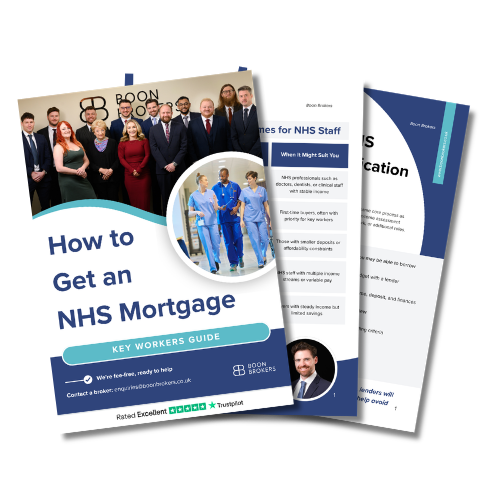
Download Our Free NHS Mortgage Guide
Sign up for our newsletter to get your full NHS Mortgages Guide – practical, shareable, and ready when you need it.
Talk to an NHS Mortgage Broker
If you’re an NHS worker earning overtime, night shifts, or weekend pay, getting a mortgage can feel less straightforward than it should. That’s because it’s not just about what you earn – it’s about how that income is assessed.
With lender criteria varying across the market, additional income isn’t always treated consistently. Without the right approach, it can easily be undervalued, directly affecting how much you’re able to borrow.
Working with a trusted mortgage broker who is accustomed to the NHS payment structure can help match you to a lender that will understand the important role overtime and enhanced earnings in your total income.
At Boon Brokers, we specialise in helping NHS staff with complex or variable income secure mortgages that reflect their true earning potential. As a fee-free, independent mortgage broker, we have access to a wide range of lenders and can match you with those who take a more proactive view of NHS applicants, overtime, enhancements, and banding.
Contact Boon Brokers today to speak with a specialist and get a clearer understanding of your options based on your full income.
To find out more about securing a mortgage as an NHS worker, you can also read our The Key Workers Guide on How to Get an NHS Mortgage, which provides a helpful overview of the process and what to expect.
Need Mortgage Advice?
Submit an Enquiry
Frequently Asked Questions
What Are the Red Flags for Lenders on NHS Income?
Lenders aren’t concerned about NHS income itself, but they do look closely at how consistent an applicant’s income appears to be. It’s common for NHS roles to include overtime and additional shifts, which can lead to some variation in income from month to month. However, fluctuations, a short track record of additional income, or changes in working patterns could be considered “red flags” for lenders, or more accurately, raise a few questions.
Ultimately, providing evidence of a clear and steady income is easier for lenders to assess and more likely to be fully considered.
How Do Mortgage Lenders Calculate Overtime Income?
While every lender has their own criteria for assessing income, most will calculate overtime by averaging your recent payslips (typically over the last three months). They then apply a percentage, often between 50% and 100%, depending on how consistent the income appears. It’s important to keep in mind that some lenders may request to look at a longer period of time in order to annualise the average to better reflect your overall earnings.
Does Weekend Pay Count Towards Mortgage Affordability?
Yes, weekend pay is usually treated as part of unsocial hours income and can be included in your mortgage application. However, lenders will expect it to be consistent and clearly shown on your payslips. If it forms a regular part of your income, a proportion may be used in affordability calculations.
Jack Freestone
I’m an established content writer at Boon Brokers, where I write and publish financial and mortgage-focused content across the UK property and lending marketplace. My work covers topics including first-time buyers, remortgaging, equity release, and wider market developments affecting borrowers. I hold a Master’s degree in English Literature from the University of Bedfordshire, graduating with distinction. Since then, I’ve worked across freelance, agency, and in-house roles, building experience writing across a range of subjects, with a focus on topics that directly affect everyday consumers. Today, my writing focuses on making complex financial topics clearer, more practical, and easier for everyday readers to understand.Related Articles
- Can You Get a Mortgage as a Newly Qualified NHS Staff?
- Can You Get a Mortgage as an NHS Locum?
- Do NHS Workers Get Better Mortgage Rates or Discounts?
- Is It More Difficult to Get a Mortgage When Working for the NHS?
- What Is the Mortgage Process for an NHS Worker?
- Which Mortgage Broker Should You Use for an NHS Mortgage?