Is It More Difficult to Get a Mortgage When Working for the NHS?

Author: Jack Freestone
Finance Writer at Boon Brokers

Reviewed by: Gerard Boon
Managing Director at Boon Brokers

Estimated Read Time: 5 Minutes
Are you having difficulties getting a mortgage while working for the NHS? It’s reasonable to expect that working for the NHS would make getting a mortgage much easier. It’s a secure sector with a strong demand for staff, along with a clear salary structure through pay bands.
In reality, however, many NHS staff have irregular payslips, work lots of overtime, or follow varying shift patterns, all of which can make it much harder for lenders to assess your total income.
In this article, we walk you through all the challenges NHS staff face when getting a mortgage, showing how lenders assess NHS income in real terms, and demonstrate how you can improve your mortgage application with a clear structure. Let’s begin.
In this article...
What Common Challenges Do NHS Applicants Face?
First and foremost, NHS applicants don’t usually face issues with mortgage applications simply because of where they work – it is more often than not how their income is assessed that tends to cause complications.
The main objective of lenders is to build a clear picture of your total income and what you can reliably afford to borrow and repay. When payslips vary or income doesn’t follow a standard structure, lenders will typically take a more cautious approach to assessing your overall affordability.
Income That Doesn’t Fit a Standard Model
It’s common for NHS employees to work overtime, night shifts, or irregular patterns, which can make monthly income less predictable on paper. While this often increases overall earnings, it can sometimes make things more complicated when lenders assess affordability.
For example, many high street lenders will tend to have a more rigid lending criteria, favouring straightforward salaried roles to lower their overall risk. Due to the added complexity of calculating additional income, NHS applicants are often assessed under a criteria used for mortgage for complex income applicants, rather than standard salaried borrowers.
The result is that your additional income may not always be fully assessed, or your chosen lender may not include overtime and enhancements in their calculations, which could reduce how much you’re able to borrow, even if your total earnings are higher.
Contract Types and Job Changes
Contract type can also play a pivotal role in how lenders will assess the reliability of your income and overall risk as a borrower. Fixed-term NHS contracts, recent role changes within the NHS, or being in a probationary period may limit your options with some lenders.
Other Common Barriers
Alongside income and contract type, there are a few other factors that can affect how your application is assessed:
 Payslips that fluctuate due to shift patterns
- Limited track record for locum or bank work
- Affordability checks that don’t fully include additional income
- Recent changes between NHS trusts or departments
- Gaps between contracts or shifts
- Income made up of multiple NHS roles
- Newly qualified NHS staff with limited income history
- Delays in payroll reflecting consistent overtime or enhancements
 Payslips that fluctuate due to shift patterns
This is where speaking to a trusted broker who understands the complexities of NHS income can make a real difference. At Boon Brokers, our dedicated mortgage experts can provide you with the right guidance so that your application can be matched to lenders who are more familiar with shift patterns, overtime, and varying contracts.
See What Our Clients Have To Say...
How Does Shift Work and Variable Pay Affect Lending Decisions?
Completing shift work or having variable pay won’t stop you getting a mortgage, but it may require providing additional evidence to lenders to help them assess your total income accurately.
In short: Most mortgage lenders accepting shift work income will focus on the consistency of your income over several months, rather than a single payslip.
By providing a clear history and pattern of income, you can help strengthen your application, with many lenders calculating an average over the last three to twelve months depending on their criteria. Depending on your chosen lender, this can include enhancements such as nights, weekends, and overtime where they’re regular.
With that said, it’s important to note that not all lenders take the same approach and each have their own specific assessment criteria. For example, some lenders may only consider your basic salary, while others take a more flexible approach and may include anywhere from 30% to 100% of your additional income.
For a more detailed look at how lenders assess NHS overtime, nights, and weekend pay, read our guide: Do Mortgage Lenders Accept NHS Overtime, Nights and Weekend Pay?
Speak to an NHS Mortgage Specialist
Get a mortgage quote that understands NHS pay structures. Get in touch.
Myths Vs Reality About NHS Mortgages
Unfortunately, there is still a lot of confusion around NHS mortgages, particularly when it comes down to what lenders will and won’t accept.
Much of this misinformation is fuelled by outdated advice or assumptions. In reality, most of the perceived barriers will ultimately come down to how different lenders assess income, rather than any restrictions that are specifically linked to NHS roles themselves.
That’s why we’ve taken the time to outline some of the most common myths about NHS mortgages, and how they compare to reality.
Myths Vs. Reality: NHS Mortgages in 2026
| The Myth | The Reality |
| There is a single ‘NHS Mortgage’ product. | There is no official NHS mortgage. It’s a term often used in marketing to describe lenders who are more flexible when assessing NHS income and employment structures. |
| NHS staff automatically get lower interest rates. | Interest rates are generally the same as the market, but you may qualify for higher borrowing amounts. |
| You need 3 – 6 months of payslips to apply. | Many lenders accept a signed NHS contract up to 3 months before your start date. |
| Lenders only count your basic salary, not overtime. | Many lenders will include overtime and enhancements, often ranging from 30% up to 100%, depending on how consistent the income is and the lender’s criteria. |
| Locum and Bank work isn’t stable enough for a mortgage. | Locum NHS staff can secure mortgages with a track record of consistent work, with many lenders requiring between 3 and 12 months of history. |
| Only clinical staff (Doctors/Nurses) get perks. | Most “Key Worker” benefits will apply to all NHS staff (Admin, Estates, etc.), though some borrowing limits vary. |
By clearing up common misconceptions around NHS mortgages, it becomes much easier to see how these myths compare to reality. This allows you to approach your application with more confidence and avoid unnecessary delays.

How Do You Improve Your Approval Chances While Working for the NHS?
Improving your mortgage approval chances as an NHS employee often comes down to how your income is presented and which lender you approach. With the right preparation, even complex income can be assessed more favourably.
Start by making sure your income is clearly documented. If you rely on overtime, bank shifts, or enhancements, consistency is key. Lenders are far more comfortable when they can see a stable pattern over several months, rather than fluctuating earnings with no clear trend.
You should also focus on the core factors affecting mortgage approval chances, including:
- Maintaining a strong and stable credit profile
- Managing existing debts and monthly outgoings
- Building a larger deposit where possible
- Avoiding major financial changes before applying
One of the most effective ways to improve your chances of securing a mortgage is by working with a lender who understands your individual circumstances. As we’ve already highlighted, many of the perceived barriers for NHS applicants come down to how additional income, such as overtime and enhancements, are assessed. Finding a lender who is familiar with NHS income structures can make a significant difference.
Working with a trusted mortgage broker, such as Boon Brokers, can help match you with a lender and mortgage that’s suited to your situation. Our advisers have extensive experience supporting NHS applicants and understand which lenders with high mortgage approval rates are more suited to variable income, taking a more flexible and informed approach to assessing earnings.
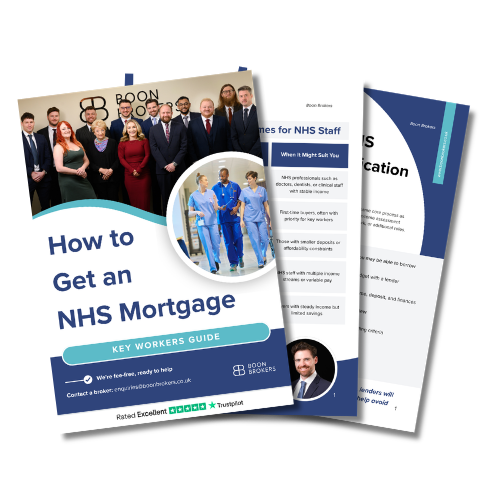
Download Our Free NHS Mortgage Guide
Sign up for our newsletter to get your full NHS Mortgages Guide – practical, shareable, and ready when you need it.
Get in Touch with a Specialist NHS Mortgage Broker
While working for the NHS can present some challenges when applying for a mortgage, these often come down to just how your income is assessed.
The key for NHS workers is understanding how your income, especially overtime, shift work, and enhancements, are viewed by different lenders. This is where having a trusted mortgage broker at your side can make your mortgage application much easier.
At Boon Brokers, we offer a completely fee-free, whole-of-market service, comparing mortgages from over 100+ UK lenders. Our dedicated experts have extensive experience in helping complex income cases and regularly support NHS applicants to find lenders that best match your needs.
Contact Boon Brokers today to speak with one of our advisers and find out about all the options available to you.
If you’d prefer to learn more first, read our free Key Workers Guide on How to Get an NHS Mortgage for a detailed breakdown of how to secure a mortgage that works for you.
Need Mortgage Advice?
Submit an Enquiry
Frequently Asked Questions
Can Locum NHS Staff Get a Mortgage Easily?
Yes, locum NHS staff can get a mortgage, but it will depend on how consistent your work has been. Most lenders will expect between three and twelve months of income history in the same field. Providing evidence of regular work and stable earnings can help improve your chances.
Does Overtime Make Mortgage Approval Easier for NHS Staff?
Overtime can strengthen your application if it’s consistent and clearly evidenced. Many lenders will include a portion of overtime in affordability assessments, with some considering up to 100% depending on their criteria. However, if overtime work appears to be irregular, lenders may choose to disregard this additional income as an anomaly, meaning it will not contribute to your overall affordability calculations.
Are Probationary NHS Contracts a Barrier to Mortgage?
No, being in a probationary period doesn’t automatically prevent you from getting a mortgage. Some lenders are comfortable with NHS probationary contracts, especially if you have a strong employment history. Others may prefer you to have passed probation, so lender choice can play an important role.
Jack Freestone
I’m an established content writer at Boon Brokers, where I write and publish financial and mortgage-focused content across the UK property and lending marketplace. My work covers topics including first-time buyers, remortgaging, equity release, and wider market developments affecting borrowers. I hold a Master’s degree in English Literature from the University of Bedfordshire, graduating with distinction. Since then, I’ve worked across freelance, agency, and in-house roles, building experience writing across a range of subjects, with a focus on topics that directly affect everyday consumers. Today, my writing focuses on making complex financial topics clearer, more practical, and easier for everyday readers to understand.Related Articles
- How Does NHS Banding Affect Your Mortgage Application?
- Can You Get a Mortgage as a Newly Qualified NHS Staff?
- Can You Get a Mortgage as an NHS Locum?
- Do NHS Workers Get Better Mortgage Rates or Discounts?
- What Is the Mortgage Process for an NHS Worker?
- Which Mortgage Broker Should You Use for an NHS Mortgage?