How Does NHS Banding Affect Your Mortgage Application?

Author: Jack Freestone
Finance Writer at Boon Brokers

Reviewed by: Gerard Boon
Managing Director at Boon Brokers

Estimated Read Time: 5 Minutes
If you work for the NHS, then you’re probably already familiar with how banding brackets shape your salary and future progression. But when it comes to applying for a mortgage, it is not always clear how different lenders will interpret different bands as income.
With multiple pay steps and projected increases, many NHS staff worry that overtime or upcoming pay rises may be overlooked. It often leaves many NHS staff wondering whether their NHS band could limit how much they can borrow, if lenders will properly count overtime, or whether it is better to wait until the next pay increase before applying.
In this article, we explain exactly how your NHS pay banding will affect your mortgage affordability, how lenders may assess salary progression, and the steps you can take to improve your mortgage application with ease. Let’s jump in.
Understanding NHS Pay Bands and Salary Progression
Mortgage lenders treat NHS pay bands and structured salary progression as a key financial factor when assessing affordability. Rather than looking only at your current salary, many lenders today will consider the stability and consistency of your earnings, including regular additional payments, to assess how reliably you can meet repayments.
As the NHS pay progression follows a clear and structured path, lenders are able to estimate both your current and future repayment capacity with relative accuracy, creating a clearer picture of how much you can realistically borrow.
Experienced mortgage brokers for NHS staff often use the structured nature of pay bands to demonstrate the reliability of your current income. This shows lenders that your earnings are stable and consistent, rather than irregular or unpredictable, helping lenders accurately assess affordability based on confirmed salary and documented additional payments.
Additional income, such as overtime, night shifts, or unsocial hours pay, can also affect your mortgage application. Lenders look at how consistently these payments appear alongside your banded salary, which can influence the amount you are able to borrow.
The table below shows the typical Agenda for Change band increases and step points according to the NHS career website. Lenders will often reference this structured progression to see how your income might grow over time.
NHS Pay Bands and Step Progression
| Band | Entry Step Point | Years to Next Step |
| Band 1 | £25,272 | N/A |
| Band 2 | £25,272 | 2 years |
| Band 3 | £25,760 | 2 years |
| Band 4 | £28,392 | 3 years |
| Band 5 | £32,073 | 2 years |
| Band 6 | £39,959 | 2 years |
| Band 7 | £49,387 | 2 years |
| Band 8a | £57,528 – £94,356 | 2 years |
| Band 9 | £112,782 | 2 years |
It’s important to note that lender policies and criteria can vary. While many lenders today will consider future earnings when assessing affordability, each lender has its own approach. Working with your lender or a trusted mortgage broker – like Boon Brokers – can help ensure your application is structured to optimise your chances of finding the mortgage product that matches your needs.
Ultimately, presenting all your income details accurately is key. By clearly documenting your NHS banded salary alongside consistent overtime and additional payments, lenders can more accurately calculate the mortgage using NHS banded salary and overtime, giving a transparent view of your affordability and helping to maximise your borrowing potential.
What Our Clients Have To Say...
How Do Lenders Calculate Affordability Using Banding?
Now that you understand how NHS pay bands and additional earnings are presented to lenders, the next question is how these figures actually translate into borrowing power.
Lenders use your documented salary, including any consistent overtime or unsocial hours pay, to assess and calculate monthly repayments that you could reasonably manage. This process forms the core part of the mortgage affordability assessment for NHS staff applicants.
As a result, the impact of the NHS pay band on mortgage affordability comes from both the predictability of your income and its structure. However, while many lenders may take overtime and unsocial hours into account when assessing affordability, they will typically require clear documentation showing evidence of these consistent earnings to reduce their risk.
Crucially, extra pay should not be overlooked. Even small differences in how earnings are presented can affect the total borrowing limits of your application.
Key factors lenders will consider include:
 Current gross salary and structured progression within your pay band
- Regular overtime or unsocial hours payments and how consistently they appear
- Existing monthly commitments and outgoings
- Lender-specific affordability criteria, which can vary significantly
 Current gross salary and structured progression within your pay band
By presenting your income clearly and consistently, lenders can calculate affordability more accurately. This not only helps ensure your application reflects your true financial position but also increases the likelihood of securing a mortgage that aligns with your borrowing potential.
Talk to an NHS Mortgage Specialist
Get tailored advice on how your NHS salary band affects what you can borrow.
Can Future Pay Rises Be Included?
One of the most common questions that we get asked by NHS staff is whether lenders will factor in their future earnings when calculating their total borrowing potential.
It’s important to note that most lenders will not consider a pay rise until it is evidenced. Even if a pay increase is scheduled, lenders will usually require confirmation in writing, such as an employment contract or HR letter, before actively including it in affordability calculations.
For example, let’s say that you’re currently on Band 4 but expect to progress to Band 6 in the future. In most cases, lenders will not include pay that is several bands ahead. In practice, lenders will always focus on your current salary and any imminent, guaranteed increases within your existing band.
In short: Total borrowing power and affordability will rarely be based solely on the expectation of a future increase.
This is why working with a trusted mortgage broker who understands NHS pay structures can make a real difference. At Boon Brokers, our dedicated mortgage experts can help ensure your application presents all elements of your income, including any overtime and additional payments, clearly and accurately.
By demonstrating your earnings clearly and accurately, our experts can help present your mortgage application in a professional way that reassures lenders of your financial reliability, helping your chosen lender assess your true borrowing potential.

Impact of Band Changes on Borrowing Power
Changes in your NHS band directly affect your salary, which in turn impacts how much you can borrow. Simply put, a higher income generally means lenders will allow a higher mortgage, as your repayment capacity increases.
As we’ve noted above, it is important to remember that your NHS band is only part of your total income. Any overtime, night shifts, or unsocial hours pay can also be included in your affordability calculations, provided that there is documented evidence and consistency.
Let’s take a look at a typical example:
- An NHS employee on Band 6 earning £40,000 per year, with an additional £4,000 from overtime.
- Their total income for affordability purposes would be £44,000. Using a typical lender multiplier of 4.5x, this would give a potential borrowing amount of £198,000.
This example demonstrates how both banded salary and consistent additional income combine to determine your total mortgage potential.
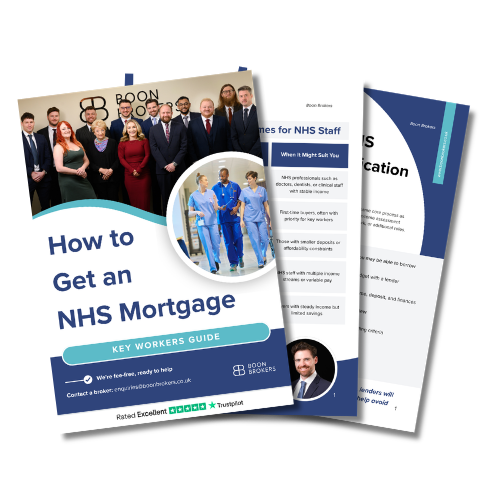
Download Our Free NHS Mortgage Guide
Sign up for our newsletter to get your full NHS Mortgages Guide – practical, shareable, and ready when you need it.
Speak to an NHS Mortgage Broker
It’s no secret that mortgages for NHS employees come with unique considerations, from understanding how pay bands and structured salary progression are assessed, to ensuring overtime, night shifts, and unsocial hours are properly documented.
Working with a trusted mortgage broker who is familiar with the NHS band brackets and how lenders will interpret your payment structure can help simplify the entire mortgage process.
At Boon Brokers, our dedicated mortgage experts have extensive experience in helping NHS employees secure a mortgage that works for them.
We compare deals from over 100+ UK lenders and explain all your options in simple, straightforward terms, ensuring you’re supported every step of the way – completely free of charge.
Need help securing a mortgage as an NHS employee?
Check out The Key Workers Guide on How to Get an NHS Mortgage or contact Boon Brokers today to let our specialists help you find the mortgage solution that matches your needs.
Need Mortgage Advice?
Submit an Enquiry
Frequently Asked Questions
Does Your NHS Pay Band Affect How Much You Can Borrow?
Yes. Your NHS pay band helps lenders assess your salary and potential progression. A higher band usually increases borrowing capacity. Lenders may also include consistent additional income, such as overtime or unsocial hours payments, if documented.
As we’ve covered in the article, it’s crucial that you present all income clearly to ensure that your chosen lender can calculate your affordability accurately, providing you an accurate picture of your mortgage potential.
Does Your NHS Band Affect Your Mortgage Borrowing Limit?
While your NHS band does not automatically set your borrowing limit, it can be the main fact for many people as it relates directly to your expected salary.
However, alongside your current salary, lenders will assess any documented overtime or additional payments, regular expenses, and credit history alongside your band. By clearly presenting all income and financial information, you help lenders calculate an accurate mortgage limit that reflects your real repayment capacity.
How Do Lenders Assess NHS Banding for a Mortgage Application?
Lenders review your payslips, employment contract, and NHS pay band to determine income reliability. They may also consider how long you have been in your current role and any imminent, confirmed pay increases within your band.
Jack Freestone
I’m an established content writer at Boon Brokers, where I write and publish financial and mortgage-focused content across the UK property and lending marketplace. My work covers topics including first-time buyers, remortgaging, equity release, and wider market developments affecting borrowers. I hold a Master’s degree in English Literature from the University of Bedfordshire, graduating with distinction. Since then, I’ve worked across freelance, agency, and in-house roles, building experience writing across a range of subjects, with a focus on topics that directly affect everyday consumers. Today, my writing focuses on making complex financial topics clearer, more practical, and easier for everyday readers to understand.Related Articles
- Can You Get a Mortgage as a Newly Qualified NHS Staff?
- Can You Get a Mortgage as an NHS Locum?
- Do Mortgage Lenders Accept NHS Overtime, Nights, and Weekend Pay?
- Do NHS Workers Get Better Mortgage Rates or Discounts?
- Is It More Difficult to Get a Mortgage When Working for the NHS?
- What Is the Mortgage Process for an NHS Worker?
- Which Mortgage Broker Should You Use for an NHS Mortgage?