Which Mortgage Broker Should You Use for an NHS Mortgage?

Author: Jack Freestone
Finance Writer at Boon Brokers

Reviewed by: Gerard Boon
Managing Director at Boon Brokers

Estimated Read Time: 5 Minutes
Not all lenders approach NHS applications in the same way and while choosing a mortgage broker might feel like a small decision, it can have a real impact on which lenders you’re actually introduced to.
It’s commonplace for many NHS roles to come with additional income, including from overtime, night shifts, and other pay enhancements. The main challenge is to understand that lenders don’t all assess this income with equal weighting which can massively impact your total borrowing power.
As such, finding the right mortgage broker for NHS staff with access to lenders who recognise and fully account for these earnings can make a significant difference to both how much you can borrow and whether your application is accepted.
In this article, we explain the A-Z on how to choose the right mortgage broker for an NHS mortgage, what to look for in a specialist, and how the right advice can help your chances of approval.
In this article...
What Are the Benefits of Using a Specialist NHS Mortgage Broker?
A specialist broker can improve your chances of approval by matching you with lenders who understand how NHS income works. The mortgage benefits for nhs staff often come down to how your earnings are assessed and whether the right lenders are considered from the outset.
A mortgage broker acts as an intermediary between you and lenders, with the goal of helping you find and apply for a mortgage that best matches your financial circumstances. For NHS borrowers, this can be particularly valuable as their income structure often includes overtime, shift allowances, and other enhancements that lenders assess differently.
In short: the best mortgage benefits for NHS staff will often come down to being matched with lenders who recognise this additional income and factor it into their total affordability calculations.
Let’s take a closer look at how working with a specialist NHS mortgage broker can help throughout your mortgage application:
Key Benefits of Using a Specialist NHS Mortgage Broker
| Feature | What It Means | Why It Matters for NHS Staff |
| Whole-of-market Access to More Lenders | You will receive a wider range of mortgage options from different lenders, beyond your bank | Increases your chances of finding lenders that accept overtime, enhancements, and bank income |
| Understanding of NHS Pay | Knows lenders who are familiar with how NHS payslips and income structures work | Helps ensure any additional income is included in your total affordability where possible |
| Experience with Complex Income | Knows lenders who are experienced in handling variable or multiple income streams | Reduces the risk of being declined due to how income is presented |
| Knowledge of Lender Criteria | Knows which lenders are more flexible, and comparatively, which to avoid | Saves time by applying to lenders that are more likely to accept your situation |
| Help with Documentation | Expert guidance on what to provide in your application and how to present it | Professional applications help prevent delays and avoids issues during underwriting |
| Clear Borrowing Guidance | Professional and realistic borrowing estimates that are based on your full income | Helps you understand your budget and avoid over or under-estimating what you will be able to likely borrow |
While this table highlights some of the key features and benefits of working with a specialist mortgage broker, there is one feature that goes beyond any list and that is assigning an experienced professional to negotiate on your behalf.
Instead of spending time chasing different lenders and understanding their individual criteria yourself, your broker will help advise you on all of your mortgage options and ensure that any potential lender already aligns with your needs.
In practical terms, while a broker doesn’t have the power to change a lender’s decisions, they can provide you with all the tools needed to significantly improve your application and ensure you are pointed towards the right lenders.
See What Our Clients Have To Say...
Whole-of-Market Vs Tied Brokers Explained
Mortgage brokers in the UK are typically either whole-of-market or tied, and understanding the difference is one of the key tips for NHS staff selecting a specialist mortgage broker.
When it comes down to choosing a mortgage broker, access is one of the most important keywords that you need to keep an eye on. Whether your chosen broker has whole-of-market access or works solely with a limited panel will affect which lenders they can approach, and as a result, how many mortgage options you’ll actually be able to consider.
As the name would suggest, brokers who have whole-of-market access can look across a wide range of lenders, comparing different mortgage products from the wider market to find one that matches your needs. On the other hand, a tied or multi-tied broker will have access that is limited to one or a small panel of lenders.
For those who work within the NHS, this can make a noticeable difference, particularly if your total income includes overtime, enhancements, or multiple roles.
To help you identify the key difference between the different broker types, we have outlined all the key features below and how this could affect your mortgage:
Key Differences Between Broker Types
| Feature | Whole-of-Market Broker | Tied / Multi-Tied Broker |
| Lender Access | Allows access to a wide range of UK lenders. | Limited to one lender or a smaller panel |
| Advice Type | Typically independent, and can advise on a broader list of different mortgage products | Restricted to specific lenders and their correlating mortgage products |
| NHS Income Flexibility | Access to the wider mortgage market increases the chances of finding lenders who accept overtime and additional income | Limited to their panel and how their selected lenders assess NHS income |
| Typical Setup | Independent mortgage advisers | Bank advisors or in-house estate agent brokers |
| Best Suited For | NHS staff who are looking to search the broader market and want to include any complex or variable income, including NHS overtime enhancements, etc. | Simpler basic salary cases or for those who want to work with a specific lender |
It’s important to note that any broker must be registered with the Financial Conduct Authority (FCA) to be able to legally provide mortgage advice and under this guidance, brokers must clearly state whether they are offering independent or restricted advice. This distinction matters, as it reflects how much of the market they can access on your behalf.
In practice, having access to a wider range of lenders can make it easier to find mortgage options that properly align with what you need. For many NHS staff, this is likely to include lenders who consider overtime, night pay, and hubshift work in their assessments to accurately reflect your full income, and therefore your borrowing power.
Speak to an NHS Mortgage Specialist
Let us help you find the best mortgage. Get in touch.
Questions to Ask Before Choosing an NHS Specialist Mortgage Broker
Asking the right questions before choosing your broker can help you understand whether they have the experience and facilities to handle your case properly.
While each case is different and advice should always be tailored to your personal circumstances, there are some important questions that all NHS staff should ask their brokers. These questions are usually focused on how your income will be assessed and which lenders they can access.
A good starting point is to determine their overall experience of working with NHS clients specifically, and how they approach different income types. For example, you could ask:
 How often do you work with NHS clients?
- Which lenders do you typically use for NHS applications?
- Do you have whole-of-market access or are you limited to certain lenders?
- Can we find a lender who includes overtime, enhancements, or bank work?
- Have you handled cases similar to mine, such as locum work or probationary contracts?
 How often do you work with NHS clients?
If you’re unsure on exactly what to ask a mortgage broker when applying for an NHS mortgage, then it’s worth focusing on how they assess income in practice. This is often where applications will succeed or fall short.
You can explore this further by asking:
- Will my full payslip be considered, or just my basic salary?
- How do you approach income that varies month to month?
- Are there lenders you would avoid based on my situation?
To be clear, the aim of these questions is not to test the broker, but rather to understand how they can help you. A knowledgeable broker should always be able to explain their approach clearly and give you confidence in how your application will be handled.

Case Study
- Problem: Sarah is a nurse who works for the NHS and wants to include her overtime and night shifts in her mortgage affordability calculations. However, her broker only uses Sarah’s basic salary, limiting her mortgage products and potential borrowing amount.
- Solution: By working with an established mortgage broker with experience of NHS applications, Sarah was clearly instructed on how to match with a variety of lenders who are willing to factor all of her income into their affordability assessment.
How Do Brokers Help with Complex NHS Income?
One of the biggest sticking points in any NHS mortgage application is how your chosen lender will assess and interpret your total income. Overtime, night shifts, and weekend work can often make up a significant part of your total earnings, but it’s key to note that lenders don’t all look at this in the same way.
Many lenders will focus heavily on your basic salary only. This is to eliminate the risk of uncertainty around additional incomes. For example, should an applicant stop working overtime, the lender might worry how this would impact the borrowers ability to make repayments.
On the other hand, there are many lenders who will have more flexibility in their lending criteria and who may include either percentages of additional income or all of the additional income in their calculations, as long as it shows consistency over time.
This is where a broker’s role becomes particularly useful. Rather than relying on a single snapshot, they’ll take the time to understand your overall situation. This should include exactly how your income is structured, how consistent it is, and what you’re looking to achieve with your mortgage.
With this understanding, a broker will then be best placed to guide you towards lenders whose criteria are more closely aligned with your circumstances. For example, instead of applying a carbon cut out one-size-fits-all approach, a mortgage broker’s guidance for irregular NHS income could lead you to a lender that accepts varying monthly incomes by applying an average over 6 months earnings.
Download Our Free NHS Mortgage Guide
Sign up for our newsletter to get your full NHS Mortgages Guide – practical, shareable, and ready when you need it.
Connect With a Specialist NHS Mortgage Broker
Choosing the right broker isn’t just about convenience, it can end up shaping the outcome of your application and mortgage from the start.
When your income includes overtime, enhancements, or multiple roles, or even if you’re an applicant with a less than perfect credit score, being matched with the right lender becomes far more important than simply applying with the first ‘headline rate’ that is available.
Taking the time to speak to the right broker for NHS mortgage approval can help you avoid unnecessary setbacks and give you a clearer understanding of what’s realistically achievable.
At Boon Brokers, we provide fee-free, whole-of-market mortgage advice tailored to NHS staff. Our dedicated mortgage experts offer access to a wide range of lenders, combined with a clear understanding of how NHS income is structured. We take the time to get to know what you’re looking for, so that you’re guided towards the most suitable mortgage products that match your needs.
Contact Boon Brokers today to speak with a specialist and start your mortgage journey with the right information.
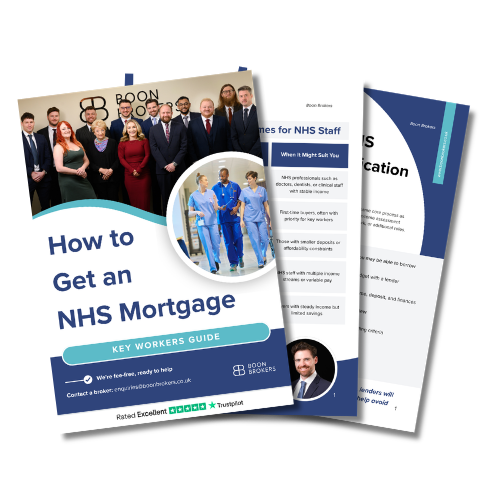
To find out more about securing a mortgage as an NHS worker, read our Key Workers Guide on How to Get an NHS Mortgage, which provides a helpful overview of the process and what to expect.
Need Mortgage Advice?
Submit an Enquiry
Frequently Asked Questions
Can a Broker Help If My NHS Contract is Probationary?
Yes, a mortgage broker can help if you’re on a probationary NHS contract. The first thing to note is that the assessment criteria will vary between lenders. Some lenders are open to applicants in probation – particularly where employment is stable – and so this would be the starting point of how a broker could help you. A trusted whole-of-market broker can help identify suitable lenders and present your application in a way that better reflects your ongoing employment.
How Does a Mortgage Broker Help With Bank Statement Income?
A mortgage broker can help by reviewing your bank statements to identify consistent income, even where it varies month to month. This can include overtime, bank shifts, or additional earnings. They then match you with lenders who are willing to assess this income more flexibly, rather than focusing only on basic salary.
Can a Broker Help Increase Borrowing Power Over Time?
Yes, a broker can help improve your borrowing potential over time by advising on how lenders assess your income and outgoings. While a broker will not be able to directly increase your borrowing power, theory can help you build evidence of a longer track record of consistent earnings, and advice on the best times to submit your application. For example, this might be at a time after you’ve improved your credit score.
Related Articles
- How Does NHS Banding Affect Your Mortgage Application?
- Can You Get a Mortgage as a Newly Qualified NHS Staff?
- Can You Get a Mortgage as an NHS Locum?
- Do Mortgage Lenders Accept NHS Overtime, Nights, and Weekend Pay?
- Do NHS Workers Get Better Mortgage Rates or Discounts?
- Is It More Difficult to Get a Mortgage When Working for the NHS?
- What Is the Mortgage Process for an NHS Worker?