The 2026 Timeline to Buying a House in the UK

Author: Jack Freestone
Finance Writer at Boon Brokers

Reviewed by: Gerard Boon
Managing Director at Boon Brokers

Estimated Read Time: 5 Minutes
Buying a house can be filled with a whole range of highs and lows. One day you might be stepping through the front door of your future dream home, already imagining the perfect sitting room layout or how you’ll set up the spare room as an office. Next, you’re buried deep in mounds of paperwork trying to figure out whether or not your mortgage application has everything your lender needs.
Don’t worry – we’ve been there. And while the end-goal is to purchase the property that ticks all your boxes, the reality is that there are plenty of moving parts involved in buying a house in the UK, especially if you need a mortgage.
Finding the right lender and mortgage product is only the start. There are affordability checks, surveys, lender valuations, conveyancing, endless back-and-forth with solicitors, and everything else in-between.
In this article, we are going to guide you through the full mortgage timeline step-by-step, defining exactly what happens at each stage, where delays can happen, and what timeline you can expect when buying a house in 2026. Let’s begin.
In this article...
- A Step-By-Step Process for Buying a House
- Step 1: Preparing your Finances and Deposit for a Mortgage
- Step 2: Getting a Mortgage Agreement in Principle
- Step 3: Searching for Properties and Booking Viewings
- Step 4: Making an Offer on a Property
- Step 5: What Happens After Your Offer Is Accepted?
- Step 6: Applying for a Mortgage and Receiving an Offer
- Step 7: The Conveyancing and Legal Process Explained
- Step 8: Exchange of Contract and Completion Timeline
- Common Delays When Buying a House in the UK
- How to Accelerate the Home Buying Process
- Final Timeline Breakdown: How Long it Really Takes
- How a Mortgage Broker Can Help You
- Frequently Asked Questions
A Step-By-Step Process for Buying a House
Estimated Duration: 3 – 6 months
The average timeline to buying a house in the UK will usually take between three and six months, although it should be noted that every purchase will move at its own pace. While some buyers might fly through the entire process with very few issues, there are others who will run into delays involving lenders, surveys, property chains, or legal work, some of which cannot be avoided and will inevitably add to the time it takes to purchase a property.
This is typically because the processes involved will rarely move in a perfectly choreographed straight line. For example, it can be common not to hear any updates for weeks, only for several stages to suddenly progress all at once. Mortgage approvals, conveyancing, and the required legal checks can all move at different speeds, depending on the property and the people involved.
With that said, while every purchase is slightly different, the overall step-by-step guide to buying a house will usually follow the same core stages, including:
 Preparing your finances and deposit
- Getting an Agreement in Principle
- Searching for properties and arranging viewings
- Making an offer
- Applying for a mortgage
- Conveyancing and legal checks
- Exchange and completion
 Preparing your finances and deposit
While this overview provides a general picture of the process, the reality is that each stage will come with its own delays, paperwork, and waiting times. To help make this process easy to follow, we’ve broken each stage down into what you can realistically expect when buying a house in 2026.
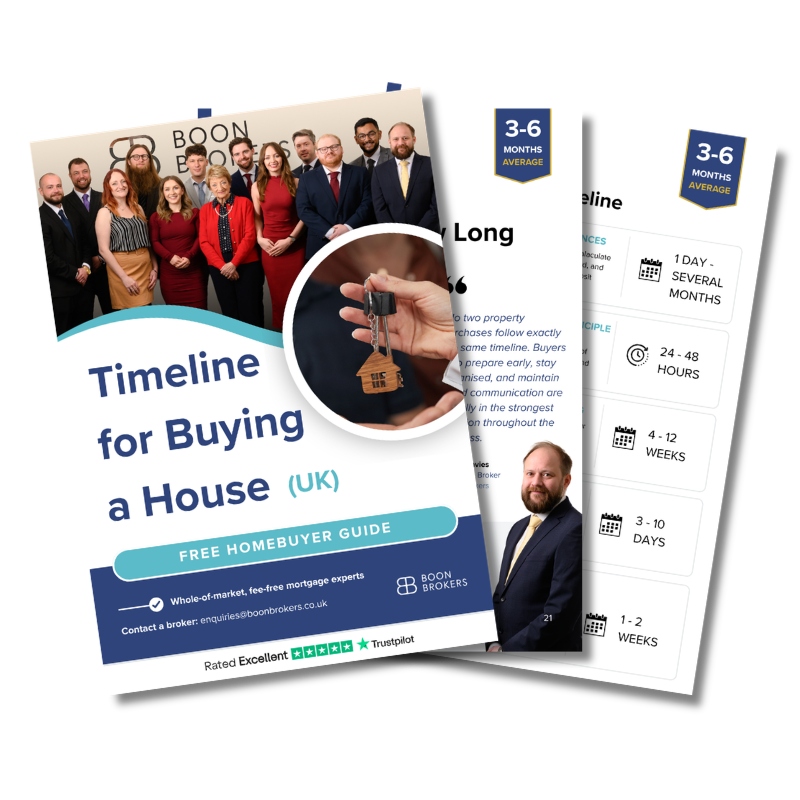
Download Our Free Homebuying Timeline Guide
Sign up for our newsletter to get your full Mortgage Timeline Guide. Simple, helpful, and completely free.
Step 1: Preparing your Finances and Deposit for a Mortgage
Estimated Duration: 1 day – months
The first step for most people is saving for a mortgage deposit. Before arranging viewings or speaking with estate agents, it is important that you have a realistic idea of both the type of property you can afford and how much a lender may actually be willing to offer you.
There are many different mortgage products that are available on the market today, ranging from 95% mortgages through to higher-deposit options with lower loan-to-value ratios. However, as a general rule, a larger deposit will usually improve your total affordability and can open the door to better interest rates.
This is why it is almost always worth taking a step back and considering what mortgage option works best for your situation long term. In some cases, waiting a few extra months to build on your deposit could give you access to more competitive mortgage products and lower monthly repayments, saving money down the line.
With that said, it’s also very easy to get stuck focusing on saving for the deposit that other costs can catch you off guard later in the process. Legal fees, surveys, moving costs, and stamp duty can all quickly add thousands of pounds to the overall cost of purchase, before contracts are even exchanged.
Questions around getting a loan for a mortgage deposit also come up regularly, particularly when family support is involved. In most cases, lenders are more comfortable with gifted deposits than borrowed ones, mainly because additional borrowing affects affordability calculations and increases overall risk.
It’s worth spending time getting paperwork organised early as well. Buyers who check their credit report, avoid unnecessary credit applications, and prepare documents like payslips and bank statements in advance often find the mortgage process far smoother later on.
For first-time buyers, it is common for family members to help towards the total deposit. Most lenders will accept gifted deposits in your application, however, evidence confirming that the money is a genuine gift rather than a loan will also be required. This helps reassure the lender that you won’t be taking on any additional debt, alongside the mortgage.
Ultimately, taking the time to get organised early can make a big difference. Checking your credit report, avoiding unnecessary finance applications, and keeping documents like payslips and bank statements ready beforehand will all help speed the mortgage application once you’re ready to apply.
We've helped thousands buy a home...
Step 2: Getting a Mortgage Agreement in Principle
Estimated Duration: 24 – 48 hours
Once your finances are in place, the next step is usually getting an Agreement in Principle (AIP). An AIP can provide you with an early estimate from a lender on how much you may be able to borrow before submitting a full mortgage application.
While it is important to note that an AIP is not a guaranteed mortgage offer, it can provide some invaluable insights that can help you shape a realistic budget, before you start to spend time seriously searching for properties.
An AIP will help you:
- Narrow down a realistic property budget
- Highlight any affordability issues early
- Reduce delays later in the mortgage process
- Show estate agents that you are a serious buyer
When searching for a property, there are many estate agents who will expect you to have an AIP before arranging viewings or considering offers. This is because sellers want the reassurance that you’re capable of progressing with the purchase, should your offer be accepted.
So, how can you apply for a mortgage Agreement in Principle?
It might be surprising to learn that securing an AIP can actually be very simple. After providing an overview of your details, such as income, employment status, and deposit amount, some lenders can provide a same-day decision.
In fact, our recent research into first-time buyers’ mortgage journey found that 46% of first-time buyers received their Agreement in Principle within one to two days, demonstrating just how quickly securing an AIP can be when all the documents and information are prepared early.
If you’re working with a mortgage broker, then this entire process becomes much easier to complete. Rather than applying to a variety of different lenders that may not suit your circumstances, an experienced whole-of-market broker – like Boon Brokers – can help narrow down exactly which mortgage lenders are more likely to work for your situation before applying for an AIP on your behalf.
During the application for an AIP, lenders will usually carry out broad and simple mortgage affordability checks in order to build an initial picture of your current finances. For example, by reviewing your total income and deposit, lenders are able to estimate whether or not the mortgage repayments appear manageable.
An important distinction to make is that the checks required for an AIP are designed to provide an early borrowing estimate rather than a full lending decision. The more detailed reviews and underwriting checks will happen once a formal mortgage application has been submitted against a specific property.
For a more detailed breakdown on how to get an AIP, read our guide: What is the Best Way to Get a Mortgage Agreement in Principle (AIP)?
See What You Could Borrow
Get a free Agreement in Principle with help from our expert mortgage advisers.
Get an Agreement in Principle
Need Mortgage Advice?


Step 3: Searching for Properties and Booking Viewings
Estimated Duration: 4 – 12 weeks
After weeks or months of saving, budgeting, and mortgage preparation, you’re finally in a position to start viewing properties with purpose, narrowing down the list to find your perfect home. Moving from affordability calculators and estimations to the property viewings can start to make the buying process “feel real”.
It’s important to note that the average time from property viewing to offer can vary significantly depending a wide-range of factors, including the current property market, property type, and property location. In addition to this, the amount of viewings each buyer will need can also vary. While some people are comfortable making an offer after one or two viewings, others might have a list of properties that they want to compare before finding the right fit.
As a general rule it is always best practice to arrange an independent survey on any property you’re seriously considering making an offer on. However, it can also be very beneficial to keep an eye out for any obvious warning signs during your viewings to help save time in the long run.
Some of the main things to look for when viewing a house include:
- Signs of damp or cracking
- Noise levels and nearby traffic
- Roof maintenance and guttering
- Parking and local transport links
If possible, it’s also worth visiting the property at different times of day before making a decision. A quiet road during the evening might feel very different during rush hour or an afternoon school-run.
For a detailed explanation of everything that you need to look out for when viewing a house, read our article on How Many Viewings Before Making an Offer on a House?
Step 4: Making an Offer on a Property
Estimated Duration: 3 – 10 days
Once you’ve found a property that you would like to make an official offer on, then the next step is to submit an offer through the seller or associated estate agent.
A common misconception here is that many people assume that they need a formal mortgage offer before viewing the house. However, that’s rarely how the process works. Before a lender can issue an official mortgage offer, they will need to carry out their own valuation of the property that you are planning to buy. This is to ensure that the property value is a suitable security for the loan in the scenario of a defaulting mortgage.
This is why having an Agreement in Principle is usually enough during the earlier stages of property searching. It will provide the estate agents and sellers with the reassurance that you’ve already had an initial affordability assessment carried out by a lender and that your offer is serious.
In the case that you’re working with a mortgage broker, this is where an established relationship with your chosen lender can make a significant difference. Communication is key and can become particularly important, especially in competitive markets, where sellers may favour buyers who appear financially organised and ready to progress quickly.
For a complete guide on how to accelerate your buying timeline, read our latest article on Which Lenders Provide the Quickest Mortgage Offers? To learn all about how a lender’s turnaround times can affect the buying process.
Step 5: What Happens After Your Offer Is Accepted?
Estimated Duration: 1 – 2 weeks
Once your offer has been accepted, the purchase starts moving into the formal legal and mortgage stages. This is usually the point where things “move up a gear” and buyers will need to start preparing documents, arranging surveys, and getting everything in place for the mortgage and conveyancing process to begin properly.
At this stage, buyers will usually begin:
- Arranging an independent property survey
- Preparing documents for the official mortgage application
- Initial contact with a solicitor or conveyancer
One important decision at this stage is when to contact and instruct a solicitor or conveyancer. While some buyers may choose to begin the legal process immediately after their offer is accepted, it can be more advantageous to only make initial contact and wait for the mortgage application to progress further before authorising any legal work to begin. This is because solicitors can still charge for work completed at this stage, even if the purchase later falls through because of a rejected mortgage application or issues uncovered further into the transaction.
The average time to buy a house after the offer is accepted is usually between two and four months, although property chains, legal delays, and mortgage processing times can sometimes extend this further.
If you want a more detailed breakdown of the entire process after an offer is accepted, read our guide on What Happens After My Offer to Buy a House is Accepted?

Step 6: Applying for a Mortgage and Receiving an Offer
Estimated Duration: 3 – 6 weeks
By this point, your offer has been accepted and surveys may already be underway, you’re moving closer to the finishing line. The next major step is the final submission of your full mortgage application so that your chosen lender can begin their formal underwriting and affordability checks.
Unlike an Agreement in Principle (in step 2), this is the stage where lenders will begin carrying out detailed underwriting checks against both your finances and the property before deciding whether they’re prepared to issue an official mortgage offer.
During underwriting, lenders will typically review:
- Payslips and bank statements
- Employment history and income stability
- Existing loans or credit commitments
- Evidence of the deposit
- Regular spending patterns
- The lender’s property valuation results
One of the many questions that we hear at Boon Brokers concerns “when to apply for a mortgage?” and “should I be applying for multiple mortgages?”
In most cases, submitting several mortgage applications at the same time is not recommended. During a full mortgage application, lenders will usually carry out a hard credit check as part of their assessment of your current and past finances.
Multiple hard credit checks within a short period can sometimes lower your credit score and may raise concerns for lenders reviewing the application, particularly if it appears you’re struggling to secure borrowing or applying with several lenders at once.
If you’re working with a mortgage broker, this is usually where their unique lender knowledge becomes particularly valuable. Different lenders assess affordability, income, and credit history in very different ways, and choosing the wrong lender early on can sometimes lead to unnecessary delays or declined applications.
At Boon Brokers, this is where your dedicated mortgage broker will start to tailor your mortgage to you. With the property details, purchase price, deposit amount, and your financial information now confirmed, our experts will review the wider mortgage market to identify lenders and mortgage products that best match your needs.
The average timeline for underwriting can vary quite a bit and will naturally depend on the complexity of the case. Straightforward salaried applications may move quickly, while self-employed income, variable earnings, gifted deposits, or more complex financial situations often require additional checks and manual reviews.
Once your mortgage offer has been sent, everything has been reviewed and approved, the lender will then issue a formal mortgage offer confirming how much they’re prepared to lend and the conditions attached to the mortgage.

Step 7: The Conveyancing and Legal Process Explained
Estimated Duration: 8 – 12 weeks
The conveyancing stage covers the legal work that takes place before contracts are exchanged and the purchase can complete.
The average conveyancing time in the UK is usually between eight and twelve weeks, although leasehold properties, long chains, missing paperwork, or management company delays can sometimes extend this further.
During this stage, solicitors and conveyancers will:
- Carry out property searches
- Review contracts and ownership records
- Raise legal enquiries
- Check mortgage conditions
- Prepare for exchange and completion
A lot of this work will happen quietly in the background, which is why the process can sometimes feel slow or unresponsive. In reality, there are a lot of different parties involved and it is often simply the fact that different people are waiting on responses from councils, lenders, sellers, or other parties elsewhere in the chain before anything can move forward.

Step 8: Exchange of Contracts and Completion Timeline
Estimated Duration: 1 – 4 weeks
Exchange and completion are the final legal stages before the property officially becomes yours.
When contracts are exchanged, the purchase becomes legally binding. Buyers will sign the mortgage contract agreement, and the deposit is transferred to the seller’s solicitor. Up until this point, either side can still withdraw from the purchase. After exchange, backing out can lead to significant financial and legal consequences.
Completion usually takes place anywhere from a few days to a couple of weeks after exchange, depending on what has been agreed between both parties.
On completion day itself, mortgage funds are transferred by the lender, solicitors confirm the transaction has completed, and the estate agent releases the keys once everything is finalised.
After months of paperwork, waiting, surveys, and legal checks, this is finally the stage where you can move into your new home.
Common Delays When Buying a House in the UK
Delays are extremely common when buying a property in the UK, even in transactions that initially seem straightforward. In many cases, the process slows down simply because several different people, companies, and legal teams are all waiting on information from one another at the same time.
One of the most common frustrations for buyers is delays in mortgage approval, although staying organised and preparing documents early can often help prevent unnecessary hold-ups later in the process.
Lenders may request additional documents, carry out further affordability checks, or need clarification on certain documentation. While it may sound cliché, preparation is always key in avoiding delays and keeping documents organised and ready to provide when lenders request them can often help reduce delays later in the mortgage process.
In addition to the mortgage process, other common causes of delays include:
- Long property chains
- Slow solicitor communication
- Survey issues or down valuations
- Leasehold complications
- Missing paperwork or identification documents
- Delays with local authority searches
Generally, making sure that good communication is maintained can make a significant difference here. Responding quickly to requests from lenders, brokers, or solicitors often helps prevent smaller issues from turning into larger delays later in the process.
If you’d like a more detailed breakdown of why applications slow down, read our guide on What Delays a Mortgage Application?
How to Accelerate the Home Buying Process
While no buyer can control every stage of the transaction, certain decisions can make a noticeable difference to the overall average time taken to buy a house.
Some of the most effective ways to help speed up the process include:
- Having an Agreement in Principle ready before viewing properties
- Saving a larger deposit where possible to improve lender options
- Choosing chain-free or straightforward properties
- Avoiding major financial changes during the mortgage process
- Working with lenders known for faster turnaround times
- Keeping regular communication with estate agents and solicitors
Preparation before you even start house hunting can often make the biggest difference. Buyers who already understand their budget, deposit position, and borrowing options usually move through the process far more smoothly once an offer has been accepted.
Having an experienced mortgage broker in your corner can make the process far easier to manage. A mortgage broker can help keep the process moving forward by:
- Identifying lenders suited to your financial situation earlier
- Avoiding lenders known for slower processing times
- Managing communication between lenders, solicitors, and estate agents
- Helping prepare documents before underwriting begins
- Spotting potential application issues before delays happen
To learn more about how an experienced mortgage broker can help your buying timeline, read our guide on Does Using a Mortgage Broker Speed Up the Process of Buying a House?
Final Timeline Breakdown: How Long it Really Takes
We’ve now explored the eight main stages involved in buying a house in the UK, from preparing your finances and securing an Agreement in Principle through to exchange and completion.
While every purchase is different, timelines will always depend on factors such as the lender you choose, the complexity of the mortgage application, property chains, survey results, and how quickly legal work progresses throughout the transaction.
To help simplify the process, we’ve put together a quick breakdown below showing the average timeline for each stage of buying a house in the UK.
Average Mortgage & House Buying Timeline
| Stage | What Happens | Estimated Duration |
| Preparing Finances | Deposit saving, affordability checks, budgeting, and credit review | 1 day – several months |
| Agreement in Principle | Initial lender assessment and borrowing estimate | 24 – 48 hours |
| Property Searching | Viewings, comparisons, and property offers | 4 – 12 weeks |
| Making an Offer | Offer submission and seller negotiations | 3 – 10 days |
| Post-Offer Acceptance | Surveys, solicitor preparation, and legal setup | 1 – 2 weeks |
| Mortgage Application | Underwriting, affordability checks, and lender valuation | 3 – 6 weeks |
| Conveyancing & Legal | Searches, legal enquiries, and contract preparation | 8 – 12 weeks |
| Exchange & Completion | Contracts exchanged and keys released | 1 – 4 weeks |
For most buyers in 2026, the entire process still takes somewhere between three and six months from initial preparation to moving day.
How A Mortgage Broker Can Help You
After seeing how many stages are involved in the house-buying process, it’s easy to understand why timelines can sometimes feel unpredictable. Between mortgage applications, lender checks, surveys, conveyancing, and property chains, there are often several moving parts progressing at the same time.
Having the right mortgage support in place can help make the process far easier to manage, particularly when delays or unexpected issues arise during the transaction.
At Boon Brokers, our dedicated mortgage experts provide free mortgage advice and help buyers progress through each of the stages, from Agreement in Principle through to receiving a formal mortgage offer. With access to the wider mortgage market, we compare lenders across a broad range of mortgage products to help match you with a lender that best suits your circumstances and borrowing needs.
Working with Boon Brokers means you can:
- Access mortgage products from across the wider market
- Receive guidance throughout the mortgage process
- Avoid common delays caused by lender mismatches
- Speak directly with experienced mortgage professionals
If you’re planning to buy a house in 2026 and want clearer guidance on your mortgage options, contact Boon Brokers today and speak with one of our dedicated mortgage experts.
Need Mortgage Advice?
Submit an Enquiry
Frequently Asked Questions
What Happens if I Buy a House From Someone Who Has Owned the Property for Less Than 6 Months?
Some mortgage lenders apply restrictions to properties that have been owned for less than six months, often because of fraud prevention rules linked to rapid resales. This does not always mean your mortgage application will be declined, but lender choice can become more limited. A mortgage broker can help identify lenders that are more comfortable with these types of purchases.
Which Month Is the Hardest to Buy a House?
Spring and early summer are often some of the busiest periods for the UK housing market, particularly between March and July. More buyers tend to enter the market at the same time, which can increase competition and place additional pressure on lenders, solicitors, surveyors, and estate agents, sometimes leading to longer mortgage and conveyancing timelines overall.
What Should I Check Before Buying a House?
Before making an offer, it’s important to look beyond cosmetic presentation and pay attention to any obvious signs of long-term issues. Damp, cracks, roof condition, boiler age, drainage problems, parking, and local transport links can all affect the property’s future value and maintenance costs. If you’re seriously considering a property, arranging an independent survey is always recommended before proceeding further.
How Do You Start the Process of Buying a House?
Most buyers begin by reviewing their finances, understanding how much they may be able to borrow, and saving for a deposit. Speaking with a trusted mortgage broker early can also help you understand your borrowing position, compare lenders across the market, and secure an Agreement in Principle before you begin arranging property viewings.
Jack Freestone
I’m an established content writer at Boon Brokers, where I write and publish financial and mortgage-focused content across the UK property and lending marketplace. My work covers topics including first-time buyers, remortgaging, equity release, and wider market developments affecting borrowers. I hold a Master’s degree in English Literature from the University of Bedfordshire, graduating with distinction. Since then, I’ve worked across freelance, agency, and in-house roles, building experience writing across a range of subjects, with a focus on topics that directly affect everyday consumers. Today, my writing focuses on making complex financial topics clearer, more practical, and easier for everyday readers to understand.